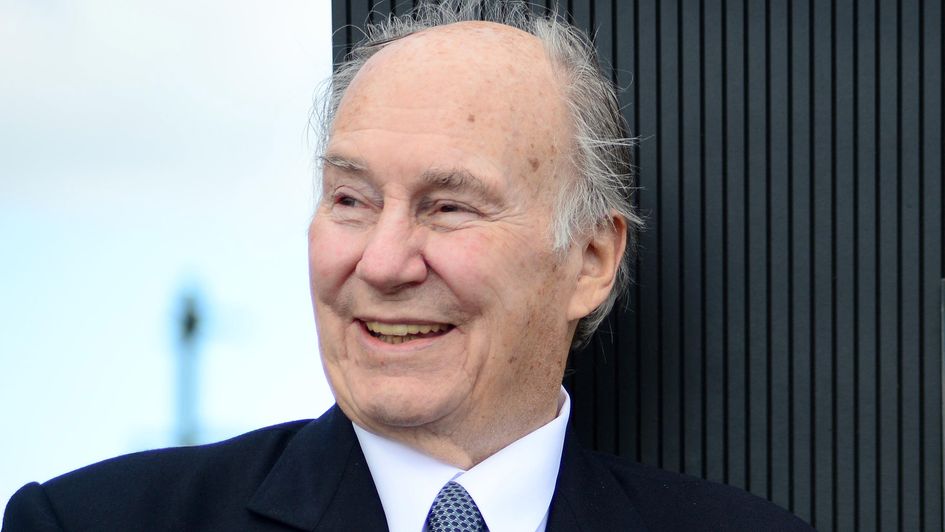
The Aga Khan, one of racing’s most renowned owner-breeders – whose long list of champions includes Shergar – has died at the of 88.
The Aga Khan became the spiritual leader of the world’s millions of Ismaili Muslims at the age of 20, as a Harvard undergraduate, and poured a material empire built on billions of dollars in tithes into building homes, hospitals and schools in developing countries.
His Aga Khan Foundation announced on its website that Karim Al-Hussaini, the 49th hereditary imam of the Shia Ismaili Muslims, died on Tuesday in Portugal surrounded by his family. It said an announcement on his successor would come later.
His huge interest in horse racing resulted in a host of all-time great horses. He won the Derby five times, with Shergar in 1981 followed by Shahrastani, Kahyasi, Sinndar and Harzand.
He also won the Prix de l’Arc de Triomphe four times, through Akiyda, Sinndar, Dalakhani and Zarkava.
But it is Shergar with whom he will always be associated. Trained by Sir Michael Stoute, the brilliant colt was an imperious winner of the Derby under Walter Swinburn.
After his retirement, he headed for a stallion career in Ireland, but it was there he was kidnapped from the Aga Khan’s stud, in what was generally accepted to have been the work of the IRA. His remains have never been found.
Aga Khan Obituary
The Aga Khan was one of a golden age of owner-breeders for European racing.
Along with the likes of Prince Khalid Abdullah and the Maktoum family, the Aga Khan’s famous green and red silks were sported by his homebred runners to incredible success after he reinvigorated his family’s already rich racing traditions in the 1970s.
Born December 13, 1936, His Highness Prince Karim Aga Khan IV was the son of Prince Aly Khan and his first wife Princess Tajuddawlah Aga Khan, formerly Joan Yarde-Buller.
The Aga Khan spent his early years in Kenya, before attending the world-renowned Institut Le Rosey boarding school in Switzerland and moving on to Harvard, where he was studying when he became the spiritual leader of the Ismaili Muslims on the death of his grandfather in 1957, at the age of just 20.
His family had already enjoyed huge racing success, with his grandfather owning no less than five Derby winners in Blenheim (1930), Bahram (1935), Mahmoud (1936), My Love (1948) and Tulyar (1952), while the influence of his great mare Mumtaz Mahal is still prevalent in the Aga Khan’s bloodstock today.
The Aga Khan inherited those racing interests from his father following his death in a car accident in May, 1960, with star filly and dual Classic winner Petite Etoile among those passed to his ownership.
It was in the 1970s that the Aga Khan really reignited the equine connection, building a new stud in Normandy, the Haras de Bonneval, in 1973 before opening the Aiglemont complex in Chantilly five years later.
The estate encompasses a 100-box training centre and the famous Les Aigles gallops, as well as a chateau where the Aga Khan resided and an office from where his worldwide business interests, which included an airline, hotels and charity work, were conducted.
The Aga Khan’s bloodstock empire was built on homebreds, although he infused new blood along the way by acquiring the late Francois Dupre’s stock in 1977, and that of the late Marcel Boussac in 1978 and Jean-Luc Lagardere in 2005, reaping rich rewards with stallion Linamix among the last-named batch of purchases.
The addition of the new runners in the late 1970s precipitated a return to racing in England for the Aga Khan, who had campaigned his runners in France to that point, with Sir Michael Stoute and Fulke Johnston Houghton being handed some of his bluebloods.
The 1979 draft to Stoute contained arguably the most famous horse ever to sport the green and red silks in the shape of ill-fated Derby winner Shergar, a sensational Epsom victor by 10 lengths in 1981 and the first of five such winners.
Of course we all know how Shergar’s tale unfolded, retired to the Aga Khan’s Gilltown Stud in Ireland at the end of a hugely successful three-year-old career, father to one crop of foals before his kidnap in 1983 by what is widely believed to have been the IRA, with his remains still undiscovered to this day.
There was further Epsom glory for Stoute and the Aga Khan in 1986, as Shahrastani held the seemingly irresistible charge of Dancing Brave.
But the Aga Khan’s love affair with British racing came to a crashing halt when his filly, Aliysa, was disqualified from the 1989 Oaks after testing positive for camphor, a prohibited substance.
Following a long battle with the Jockey Club, the Aga Khan – whose daughter Princess Zahra Aga Khan is also a successful owner – withdrew all his horses from Britain in response to what he felt were failings in the British testing system, with Stoute and Luca Cumani losing a good chunk of their strings as a result of the decision.
He finally ended his self-imposed boycott of British racing at Royal Ascot in 1995, before again sending horses to be trained by Cumani and Stoute, with future champion Kalanisi and Derby second Daliapour seemingly cementing a renewed relationship with Cumani, who had trained his 1988 Derby victor Kahyasi.
However, their association came to another abrupt halt in 2000 when two of the owner’s horses trained by Cumani returned positive tests, prompting him to remove 30 horses from the Newmarket-based Italian.
He continued to have horses with Stoute, but the Aga Khan’s interests were once again concentrated in Ireland and France.
In 2008, his brilliant unbeaten champion filly Zarkava, trained by Alain de Royer-Dupre, won the Prix de l’Arc de Triomphe and was named Cartier Horse of the Year. Five years earlier the Royer-Dupre-trained Dalakhani was equally stunning in the Arc.
In 2013 it was announced John Oxx would not receive a new batch of Aga Khan yearlings – bringing to an end a glorious run of success that included Sinndar’s never to be forgotten Derby, Irish Derby and Arc treble in 2000.
The Aga Khan’s Irish stars were instead concentrated with Dermot Weld, who provided a fifth Derby win in 2016 with Harzand, who memorably triumphed under the late Pat Smullen, despite picking up a foot injury on the day of the race. Harzand went on to give the Aga Khan a fifth Derby and Irish Derby double when scoring at the Curragh later the same month.
It was Weld who also produced the Aga Khan’s last British Classic winner in the 2024 Oaks victor Ezeliya.
The Aga Khan’s sporting interests extended further than racing and he was a highly accomplished skier who represented Iran at the 1964 Winter Olympics, taking on the slalom, giant slalom and downhill events.
He was also a long-term friend of Queen Elizabeth II, gifting her the filly Estimate, who went on to a famous success in the Gold Cup at Royal Ascot – a meeting where the pair would often watch together.
A notable supporter of Irish racing, the Aga Khan was one of the driving forces behind the redevelopment of the Curragh, with the plan eventually coming to fruition in 2019 when he joined the then Taoiseach Leo Varadkar to officially unveil the new Aga Khan Stand.
The Aga Khan is survived by three sons and his daughter.
The Aga Khan's most famous horses
The death of the Aga Khan leaves a big hole in European racing and his famous green and red colours will forever be synonymous with some of the greats of the Turf.
Here, we take a look at some of his best.
Shergar (Sir Michael Stoute)
Shergar is one of the most famous racehorses in the world, and not just because of his 10-length romp in the 1981 Derby. Ridden by teenage jockey Walter Swinburn and trained by Sir Michael Stoute, Shergar was something of a freak. His record Derby win preceded a victory in the Irish version and he then beat his elders in the King George VI And Queen Elizabeth Stakes at Ascot. His sole defeat at three came in the St Leger. However, it was off the track that Shergar came to wider prominence, when in 1983 he was kidnapped from his Irish stud by men thought to be from the IRA. His remains have never been found.
Zarkava (Alain de Royer-Dupre)
Zarkava was arguably the Aga Khan’s greatest equine achievement. Homebred, from a long list of his own mares, she was a little out of the ordinary. Having made her debut in the September of her two-year-old season, she went on to win a Group One on just her second start. She won her trial for the French Guineas easily before beating none other than Goldikova in the Poule d’Essai des Pouliches. Further victories in the Prix de Diane and Prix Vermeille followed, before her finest hour, a two-length victory in the Prix de l’Arc de Triomphe. She went unbeaten throughout her career.
Sinndar (John Oxx)
The Aga Khan struck up a very useful partnership with Irish trainer John Oxx and Sinndar perhaps does not get mentioned when recalling the greats as much as he should. He was only defeated once in eight races, winning the English and Irish Derby, the Prix Niel and the Prix de l’Arc de Triomphe. He had also won the National Stakes as a juvenile. He beat Sakhee at Epsom, who would win the Juddmonte International and Arc the following year, while at stud he went on to produce Youmzain, famously second in three Arcs.
Alamshar (John Oxx)
Another top-class colt trained by Oxx for the Aga Khan, Alamshar won both his starts, including the Beresford Stakes. Beaten on his return at three in the Ballysax, he won the Derrinstown Derby Trial but was third at Epsom behind Kris Kin. Sent to the Curragh for the Irish Derby he was running in the Aga Khan’s green and brown second colours, with Dalakhani, the French Derby winner, the odds-on favourite. Alamshar won by a length, though. His best performance was undoubtedly on his next start at Ascot in the King George, however, as he left a top-class field that included Sulamani, Nayef, Bollin Eric and Falbrav trailing in his wake. Back in third was Kris Kin.
Tarnawa (Dermot Weld)
In later years the Aga Khan had a large majority of his horses in Ireland trained by Dermot Weld, with Tarnawa proving the best of them. Only 11th in the Oaks at Epsom at three, she looked a long way from the star she would eventually become at that stage. Given a break by Weld, she hinted at what was to come in the second half of the season when winning the Blandford Stakes. But it was as an older horse she thrived, although not out until August when she won a Group Three. She went on to complete a Group One hat-trick in the Prix Vermeille, Prix de l’Opera and Breeders’ Cup Turf. Returning as a five-year-old with the sole aim of winning the Prix de l’Arc de Triomphe, she narrowly came up short when second to outsider Torquator Tasso.