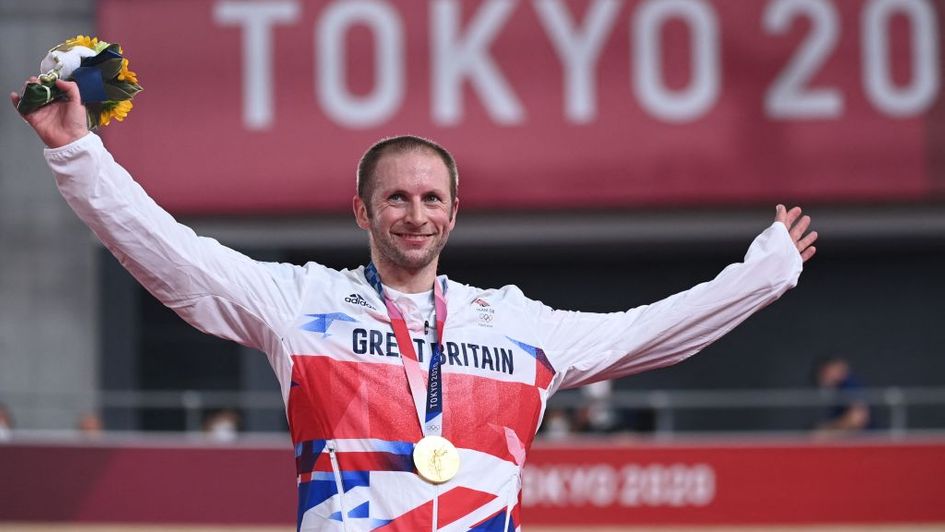
Britain’s greatest Olympian Sir Jason Kenny admitted to being “a little bit sad” but excited as he announced his retirement from racing in order to move into coaching.
The 33-year-old has this week formally begun work as British Cycling’s men’s podium sprint coach, overseeing riders who were team-mates until his appointment.
Kenny, who won a stunning keirin gold in Tokyo last summer to claim a seventh Olympic title 13 years after his first in Beijing, had been planning to keep going until the Paris Games in 2024 but said the opportunity to coach the British squad was one he could not pass up.
“It wasn’t an easy decision,” said Kenny, who was knighted in the New Year Honours List. “I genuinely wanted to carry on to Paris, but I creak quite a lot these days and I always knew I wanted to go into coaching off the back of it, and this opportunity came along.
“I am a little bit sad to be honest because all I’ve known is riding and competing, but I’m quite excited to get stuck into the job.”
Kenny's Seven Golds
Team Sprint – Beijing 2008
- Kenny made his Olympic debut in 2008 on the back of a fifth-placed finish at the preceding World Championships in Varese, Italy. Chris Hoy, Kenny and Jamie Staff had been beaten by the French in the World Cup in Manchester a few months earlier but fortunes flipped in Beijing and the British trio took victory by more than half a second. Kenny had to accept silver behind Hoy in the individual event, however.
Team Sprint – London 2012
- Hoy and Kenny were back in action together in London, this time joined by Phil Hindes. They broke the world record in both the first round and the final to take gold with a time of 42.6 seconds, with France once again settling for silver. There was a degree of controversy over the event, however, with Hindes appearing to admit he deliberately crashed to force a restart after getting away slowly during qualifying.
Individual Sprint – London 2012
- Teams were only allowed to enter one rider in the individual sprint in London and though Hoy had taken gold in Beijing, it was his younger team-mate who got the nod on home turf based on his superior results at the preceding World Championships. Kenny delivered, breaking Hoy’s Olympic record to qualify fastest in a time of 9.713 before beating France’s four-time world champion Gregory Bauge 2-0 in the final. It was the first time Kenny had beaten Bauge head to head.
Team Sprint – Rio 2016
- With Hoy having retired, Callum Skinner joined Kenny and Hindes in the team sprint and there was no let up as they set an Olympic record in qualifying. New Zealand went even faster during the first round to keep them on their toes, but the British trio responded in the gold medal race, winning in a record time of 42.440 seconds.
Individual Sprint – Rio 2016
- Britain were back to two riders in the individual competition as the rules changed again in 2016, with Kenny and Skinner in the mix. Bauge and Denis Dmitriev had been dominating individual sprints since London with Kenny quiet until he beat Australian Matthew Glaetzer to gold in the 2016 World Championships. It was clear he had peaked at the right time as he broke his own Olympic record to top qualifying ahead of Skinner – who he eventually beat to gold in the final.
Keirin – Rio 2016
- Kenny completed a clean sweep of the sprint events with victory in the keirin. Kenny survived a possible disqualification after he and Malaysian Azizulhasni Awang passed the motorised derny too soon but judges settled on a restart – and Kenny beat Matthijs Buchli to the line in the final. Victory moved him level with Hoy on a record six gold medals.
Keirin – Tokyo 2020
- Kenny became the first Briton to win seven Olympic gold medals as he took a stunning victory in the men’s keirin final in Izu. He had complained of being out of form during the men’s sprint earlier in the week but you would not have known it from the way in which he rode away from the field to win by a yawning gap of 0.763 seconds from Awang.
The move was not long in the planning. British Cycling advertised for the role on LinkedIn last month, ironically illustrating the advert with a picture of Kenny, who chose to put in what he called a “speculative” application a day before the deadline without discussing it with senior coaches first.
“The job ad came up and I ummed and ahed a bit,” added Kenny. “I was full-time training at the time, but I’ve started to ache a lot more these days.
“I thought, I don’t even know if I’m going to make it to Paris, so I could commit for three years and get nothing out of it.
“This opportunity might not come here again. If they got a good coach they could be in the role for potentially 10 years, so I thought I’d go for it now…I think if I hadn’t got the job I would have carried on (racing) in all likelihood.”
Kenny has retired once before, silently stepping away after winning team sprint, individual sprint and keirin gold at the 2016 Rio Games, without announcing his decision until he reversed it a year later.
This time it is more definitive and, Kenny said, much harder.
“Last time I didn’t realise it but I was just cooked,” he said. “I’d never really taken a break (in 10 years), so I just stepped away. Because I never planned on coming back I completely switched off and got that re-fresh.
“And since I came back into it I’ve really enjoyed it again. So this time I’m absolutely loving it, so now I’m going to quit!
“In Rio I was quite happy to see the back of it. But then since coming back and being refreshed it’s a lot harder to walk away.”
Kenny said the decision had been taken jointly with his wife Laura, Britain’s most successful female Olympian, who won her fifth gold with victory in the Madison alongside Katie Archibald last summer.
He replaces Scott Pollock, who had served as sprint coach in an interim role following the dismissal of Kevin Stewart in November 2020.
Kenny’s new role will involve longer hours and more travel than racing as he will no longer pick and choose competitions and training camps, but Kenny believes it will also allow him more quality time with their son Albie, who turned four last August.
“Athletes’ days off are not really off – you’re planning for the next day,” he said. “It basically consists of not doing anything too arduous and fuelling right…
“You can’t just go and play football with Albie or whatever. Now I think I’ll have less time off but I’ll be able to enjoy it more.”
Kenny has already begun one training course and plans to do more in the coming months – aware that the clock is already ticking towards Paris – and said he had been “floating around” in an unofficial coaching role during recent sessions in Derby.
There may be no substitute for racing, but Kenny hopes coaching will come close.
“I get a buzz off the high performance process,” he said. “Hopefully I’ll get that from the coaching side. That’s what I really enjoy, to get to the tiniest details and get it to as near as perfect as physically possible.”
Kenny’s retirement now means his final race as a professional was the show-stopping keirin victory at the Tokyo Games. Having struggled in the individual sprint, Kenny broke clear of his rivals as soon as the derny pulled off and defied all expectations to stay clear for three laps.
“It is (a great way to sign off),” he said. “I’m dead happy with that. It was really special. To do it on that bike, the last day of the Olympics, for me that’s a really special moment in time.
“If I could have picked a day to end on, that would be the one.”