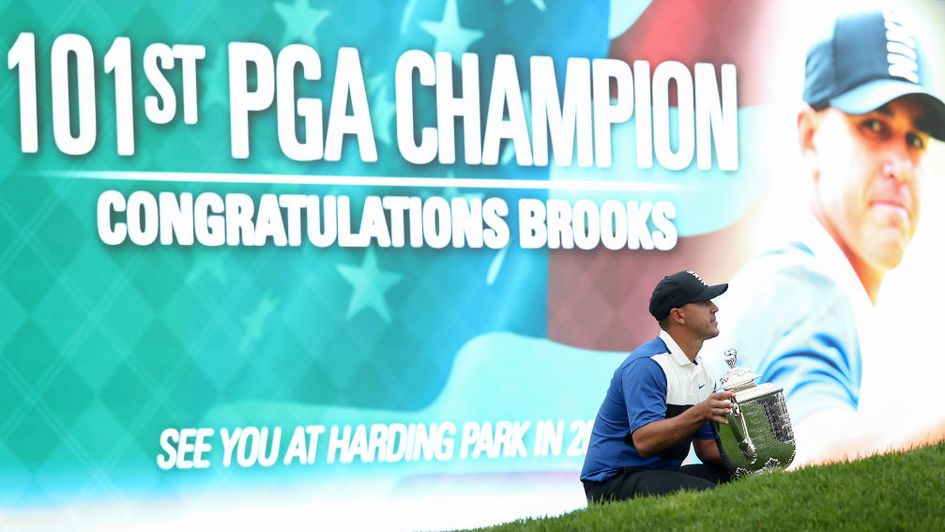
The only way Brooks Koepka was going to fail to win the PGA Championship was to do something nobody had done before: blow a seven-shot lead entering the final round of a major. He very nearly did it. And yet, in hanging on grimly and winning by two, he entered the history books in the way we had expected after all.
Tiger Woods, Jack Nicklaus, Arnold Palmer, Gary Player - none managed to defend both the US Open and the PGA. Woods defended the PGA twice, but never the US Open. Nicklaus managed only the Masters, Palmer the Open, Player none of the four. At 29 years of age and playing in an era of unrivalled competitiveness, Koepka is doing things that were never done by the greatest players in history.
Four majors in less than two years suggests Koepka is on his way to joining them, and the fact is that he was in a different league for much of this tournament. Having taken the lead at breakfast time on Thursday, he never let it go. Yet much of the final analysis will centre on the only stretch of golf there was to analyse: those closing eight holes, over which he began to back-pedal so vigorously that it became a question of whether Dustin Johnson could find one more birdie.
Dropped shots at holes 11, 12, 13 and 14 married with Johnson's birdie at 15 meant that what had been a seven-shot lead was now one. Just as importantly, Koepka's long-game control had disappeared with the arrival of a cool headwind and no longer were his hands able to save him. One player was moving forwards, the other back, and any second now their paths would cross.
But then Johnson made a vital error, one which may have cost him the tournament. Blood pumping and heart racing, however languid his stride remained, he fired a six-iron into precisely the wrong spot behind the 16th green. Unable to get up and down, he had loosened the noose around Koepka's neck when he ought to have been kicking away the stool.
As is so often the case at a course so devilishly cruel as Bethpage, one mistake led to another, and as he began the closing three-hole stretch, Koepka had been presented with a three-shot lead. It took three and three-quarter days for this to become a test of survival and in that time the leader had built up enough of a cushion to survive.
And so it is four majors after all. Four majors in 23 months, the sort of spell we saw from Rory McIlroy and, almost, from Jordan Spieth. Koepka came through his Valhalla and his Birkdale in one, and in time he might even be stronger for having briefly looked weak. Perish the thought.
Then again, neither McIlroy nor Spieth have since added to their respective collections. The way Koepka is viewed heading to Pebble Beach next month may have altered despite the fact that never once did he surrender the lead. This magnificent victory should not be undersold, but all the talk of how comfortable he is in this arena suddenly looks just a little less convincing.
Will four become ten, his own target? Who knows. Perhaps the only thing left to say is that on the right sort of golf course for him, Koepka ultimately led after every round of the 101st PGA Championship and won it. Perhaps had that wobble occurred on Friday we'd just be talking about a fourth victory. Perhaps, in the end, that's what he deserves.
It took Koepka just one hole of this tournament to set out his stall. Starting on the 10th, he waited patiently as Tiger Woods and Francesco Molinari chopped their way towards the green, before finally it was his turn. From 40 or so feet, in went the birdie putt and in 500 yards of golf he'd given himself a three-shot head start over two of those meant to pose a threat.
Five or so hours later, Koepka rolled in another lengthy birdie putt, the 63rd and final stroke of a startling round. It was to prove the lowest of the week, only Danny Lee and Adam Scott so much as managing to get within one of it. From that moment, the tournament was under his spell.
On Friday, Koepka once again began his day with a birdie, one which got him to eight-under in 19 holes. Nobody else got as far as nine-under at any stage in the tournament, whereas Koepka had left it behind and set up camp at double-digits before the event reached its midway point.
For good measure, his second-round 65 was bettered by only one player, Scott, and that meant for a seven-stroke halfway lead. No longer was the challenge about finding and taking opportunities - it was about avoiding disaster, which is easier to do when your miss is a 345-yard drive into the first cut of rough. By the time he'd finished shooting a ho-hum 70 in round three, the lead remained seven.
And so there was an undercurrent of anticlimax throughout the early stages of Sunday's final round. Not even a two-shot swing against Koepka at the very first hole was enough to stir something, because the expectation was that Harold Varner III would eventually come to realise the gravity of the situation. That he did, at the third and then the fourth, a run of 37 holes without a dropped shot ended by a double-bogey and another double-bogey.
Johnson, on the other hand, found something just in time. Having birdied the fourth and the sixth and the ninth to become the second man in the tournament to get to eight-under, he hunkered down for the back-nine and, who knows, had he played it in level-par it might have been enough to force one more mistake from Koepka.
But Johnson blinked, Bethpage didn't, and the task for Koepka had been made easier. The way he three-putted for bogey at the 17th and missed left at the 18th tells us that the infallible Koepka was suddenly there for the taking. In the end, nobody was good enough to go through with it. Yet again, the best player won.