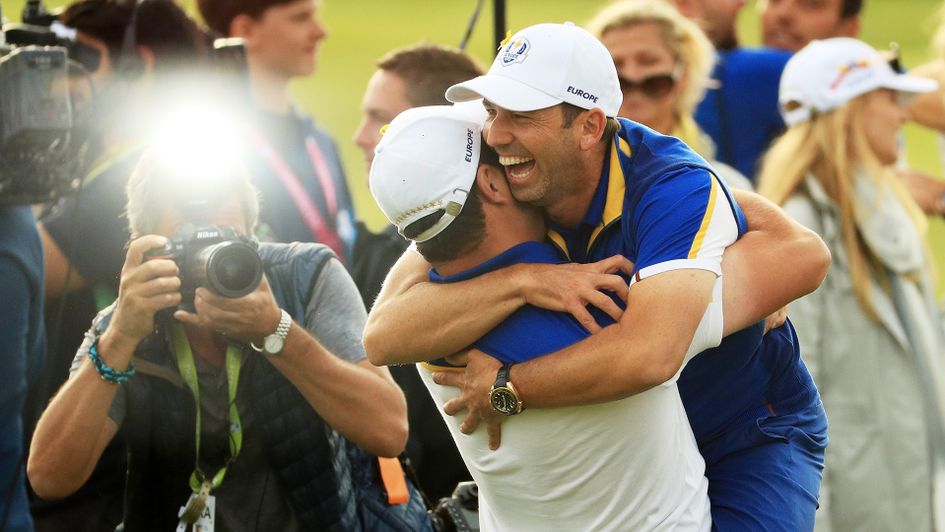
Ben Coley reflects on Europe's 17.5-10.5 Ryder Cup victory over America as he wraps up our coverage from Paris.
Briefly, it was close. At around three o'clock local time appeared a flicker of hope for the United States; the Phenomenon of Paris was on. In the end, though, Europe did as they have done all week, producing a calm, ruthless deconstruction of American hope, ultimately for a victory as decisive as any since 2006.
The conclusion of the match was fitting. Francesco Molinari, the star of the opening two days alongside partner Tommy Fleetwood, secured the winning point to become the first European in history to win all five at a Ryder Cup. Equally apt was the manner in which this point was won, Phil Mickelson hitting a ball sideways into water.
A margin of victory as wide as seven means that pinning it to any one factor would be unfair, but it's easy to argue that Europe's team dynamic was again stronger. Rory McIlroy spoke afterwards of "friendships that will last a lifetime" and highlighted the fact that all 12 players had contributed to a total of 17.5 points, this after suffering a painful personal blow as he somehow lost a top match he ought to have won.
The contrast between those words and the body language of Tiger Woods throughout the week was stark. Woods, who lost his match to an ebullient Jon Rahm, was at his most boisterous making an eagle on the ninth, but this sort of behaviour was needed to rouse his partners earlier in the week. It's telling that when separated from him, Patrick Reed returned to his Ryder Cup best to beat Tyrrell Hatton.
Mickelson was a key part of America's Ryder Cup romp at Hazeltine but will surely now end his Ryder Cup career without a victory overseas, his stretch in the side beginning in 1995, two years after that distant memory of a successful US raid on European soil. An Open champion can play golf anywhere, but not this time, and one wonders whether having Woods back in the team room upset Mickelson's perception of his own role, too.
To their credit, and that of their captain, Jim Furyk, the United States still found something in darkness midway through the final session, before Woods succumbed to Rahm and, later, Mickelson to Molinari. As Justin Thomas beat McIlroy with two stunning shots to the final hole and Tony Finau ended Fleetwood's winning spree, there suddenly lay a path to victory, or at least to the 14 points they required to keep the trophy in a draw.
Paul Casey stopped the bleeding, a half point against Brooks Koepka coming courtesy of a courageous birdie at the 17th. The Englishman, back from a Ryder Cup exile at least partly self-imposed, has grown to appreciate what this event means and played beautifully all week. One inch to the right and he'd have ended it with victory over an American stud, but this was the closest match of the week and the result was fair to everyone.
Still there was some concern for Europe, but it was gradually disappearing. And, as Rahm recovered from missing a putt of no more than three feet at the 16th to then win his match on the 17th and Thorbjorn Olesen hammered home one final blow in a 5&4 victory over Jordan Spieth which will have tasted oh so sweet, it was now clear: Europe would win the Ryder Cup, the only question by how far.
Ian Poulter, Sergio Garcia, Henrik Stenson and Molinari were all on course for victory, and first to complete the job was Poulter. The so-called Postman of the side failed to deliver on Saturday, but relished the prospect of defending an unbeaten singles record against world number one Dustin Johnson, who threw everything he had at his rival but lost when Poulter out-drove him on 18 before pounding a killer blow to six feet.
Molinari, the small man from Turin once considered too timid for this arena, then pushed Europe over the line. If golf is a game of Goliaths, this was a victory, another victory, for the Davids of this world; another triumph for accuracy, precision, composure and perseverance. Molinari has peaked at 35 and was the spine of this team, all the time deflecting praise onto the shoulders of those who've stood on his.
Stenson's victory was as straightforward as any, but Garcia's was prolonged by waywardness as he closed in on his own place in the record books. The Spaniard finally sealed it at the 17th to become the highest-scoring player in Ryder Cup history, no small feat for a man some felt ought not to have been part of the team. Bjorn was never one of them. His unwavering faith in Garcia was rewarded with another fine performance at the end of a difficult year and every success in this team, pairs and personal, owes something to the Dane.
Tellingly, the four men selected by Bjorn to supplement eight qualifiers were all instrumental in the outcome, delivering three and a half points from four on Sunday and more before that. The opposing US quarter managed two points between them, both from Finau, sure to return to the side in two years. Beside Furyk stood a collection of vice captains who might have coped better with the demands of the golf course as some of his senior players let him down quite badly.
It's unclear what America can take from this, except a dose of reality whether they needed it or not. Winning the Ryder Cup in Europe has proven beyond two of the greatest players in the history of the sport and it is far from certain that their successors, the likes of Thomas and Koepka, will fare any better.
They should at least remain hard to beat on their own turf, especially at places like Whistling Straits, where the Ryder Cup heads next. Until then, Europe will take back the Ryder Cup thanks to a group of 12 players who did what all great teams do: they produced something greater than their individual talents alone should be able to.
For that, much credit goes to Bjorn. Fifteen years on from the near miss at St George's which cost him a place in major folklore, he has earned the right to be considered the latest European Ryder Cup captain of the highest quality. Before the event he talked of the wonder of Europe and the togetherness of his team. Both were on full display here in Paris.