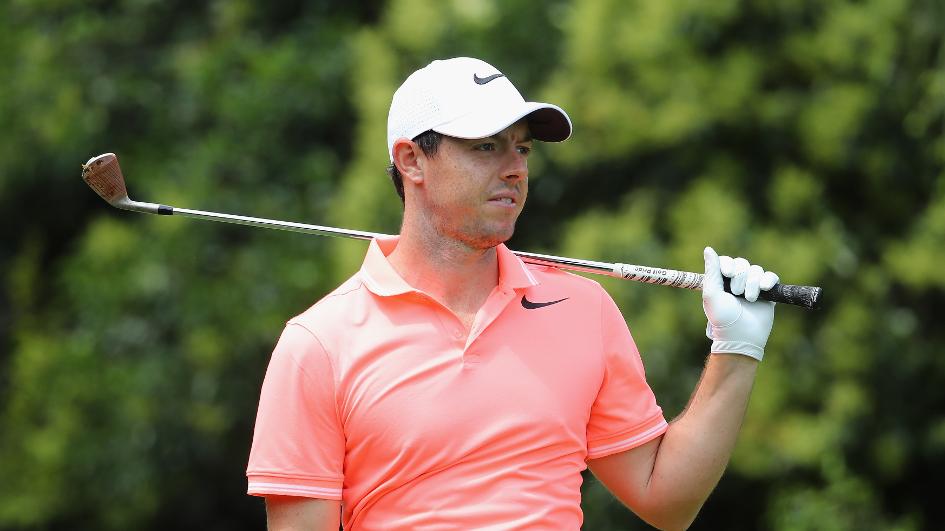
In his latest column, Ben Coley says Rory McIlroy was wrong to play golf with Donald Trump - and compounded the error with his indignant statement.
Throughout his career, one for which the hallmark has been a rare brilliance the sport has seldom seen before, Rory McIlroy has managed to put his foot in it rather often.
The Ryder Cup was ‘an exhibition’ of no importance to him; The Open and links golf in general was too much about luck; playing competitive football in the gap between the US Open and the Open Championship was a good idea.
Part of the allure of McIlroy, together with his brilliance, is his willingness to change his mind and to admit to having made a mistake. In regards all three of these errors, he has done so.
The Ryder Cup is now important - ‘the ultimate buzz’ - and anyone who saw his match for the ages against Patrick Reed will understand what it means to him. McIlroy is Europe’s talisman and their success over the next decade will rely plenty on his ability to produce towards the end of another long, hard season.
The element of luck involved in The Open is not unique to that event, and it should not detract from it. Having won the famous Claret Jug in 2014, it’s clear that McIlroy is now firmly on board and he was even before that triumph. Expect him to add a second at St Andrews and don’t rule out a third or a fourth elsewhere.
Playing football in the gap between the US Open and the Open Championship isn’t something McIlroy is now doing. In 2015, a footballing injury cost him a chance to defend his title at the aforementioned St Andrews, which was sodden and there for the taking, and left him undercooked for a PGA Championship dominated by his key rivals.
Even the Olympics, an event for which McIlroy hid behind concerns over the Zika virus which he now admits were not genuine, sparked a turnaround. McIlroy confessed to have been ‘somewhat proven wrong’ by the success of the event, even if there remains dispute as to just how successful it was.
Last week, though, McIlroy was in no mood to apologise after reports emerged that he had accepted a late invitation to play golf with Donald Trump.
Not only was McIlroy unapologetic, he was indignant. Indignant that a round of golf should mean so much to so many; indignant that his decision to play that round of golf alongside the most controversial president in American history should be taken as a political statement or endorsement.
In time, perhaps he’ll apologise, if not for playing the round of golf then for a gross misunderstanding of the situation. When you are the biggest star in a global sport but one whose modern home is the United States, playing golf with the President of the United States is a political statement; it is an endorsement. It matters.
One of the ways in which McIlroy’s honesty and accessibility is displayed is through social media, which is where his hand-crafted, iPhone-captured attempt at justification appeared – not through an agent, not through an official website, but through Twitter, written on a plane or between buckets on the range. It’s another part of the draw.
Except this time, he would’ve been wise to call in help. Because the indignant McIlroy attempted not for the first time to paint himself as a mere spectator to something insignificant - to an entertainment show he can watch after rounds in his hotel room.
But this is real life in the United States and those to whom McIlroy represents an icon do not have the luxury of ambivalence. Whatever your politics, wherever you go for news, whomever you champion, for normal people this is not time for popcorn and there is no rewind button.
McIlroy’s reluctance to enter political debate can be traced to his upbringing, but in a statement aimed to reiterate that he does not wish to take sides, he has in fact separated himself. Not perhaps from those with whom he’ll come into personal contact – the PGA Tour is overwhelmingly Republican – but from those who, rightly or wrongly, look up to him and support him.
His choices are far narrower than he would like. Just over a week ago, he had two: to play golf with the president, or to politely decline, calling upon the injury which has sidelined him for a month as an excuse with merit.
The latter would’ve spared him outrage, much of which of course is inappropriate. But by his own admission McIlroy is engrossed in American politics, and the opportunity to put down the popcorn and walk shoulder-to-shoulder with the president was one he could not resist. Sad.
Players to watch
It’s with mixed emotions that this column celebrates a winner in Rickie Fowler, who was demonstrably absent from my betting preview of the Honda Classic. It was a price thing so there’s little more to say.
What Fowler’s performance – and those of several in behind – does underline is the significance in the switch from west coast to east, as highlighted last week. Runner-up Morgan Hoffmann, a 500/1 chance on the back of some poor form in California, is perhaps the best example. Not one of his top 10 performances on the PGA Tour has come west of Denver.
Much of the next four months of PGA Tour golf will be played on the east coast, so we’ll put Sean O’Hair in the notebook on account of the fact that two of his four wins have come in Florida and he was raised in Texas.
O’Hair might not have fulfilled the promise of his youth but he’s very close to contending following another up-and-down week which ended in a share of 11th. As a former winner of the Valspar who would also have won at Bay Hill were it not for an inspired Tiger Woods, the next two events in Florida are perfect for him.
It’s also worth noting Nick Watney’s T14 in the Honda, his second such finish in three events – the meat in the sandwich a respectable tie for 28th at Riviera. These are very positive signs for a player with obvious similarities to O’Hair who is putting the pieces of his career back together.
Finally, Aaron Rai’s tie for seventh in the Joburg Open confirms him as one of the potential stars of the Challenge Tour season, when it begins. He led the field in greens and ranked seventh in accuracy and it’s that kind of ball-striking which looks sure to bring success in 2017.
Rai turned pro at the tender age of 17 and, just a week short of his 22rd birthday, has amassed plenty of experience. I’ll be surprised if he’s not a European Tour player in 2018 having picked up one or two wins on the second tier in the interim.