The final round of the Open was alive as a contest for all of a few seconds, from the moment those surrounding the first tee murmured that something might be wrong with Scottie Scheffler's opening tee shot, to the time it kicked right, into the first cut, perfectly safe.
As if to emphasise how preposterous we all were acting in those few seconds, Scheffler hit his second shot to within a few inches of the hole.
His lead had not actually increased, but somehow you felt the game was up. Six years ago it was a nervous bogey save which set Shane Lowry on a path to resounding victory. Earlier on Sunday, when asked how big a challenge it is to nurse a big lead in the final round of the Open, Lowry laughed, an admission that he and Scheffler are not the same. He knew it wouldn't be a problem.
'Another nail in the coffin' is how Wayne Riley described the birdie at the fourth, but by now the rest of the field weren't so much set to be buried beneath the earth as fired off to a distant planet, unfit to occupy the same world as Scheffler. He is, it seems certain now, the best golfer this game has seen since Tiger Woods. That will be made official when he wins a US Open to complete the career grand slam.
The latest to do that, Rory McIlroy, himself an all-time great, was never allowed into this. That would've required Scheffler's approval or else something altogether more spectacular than a couple of birdies and a bogey through the first five holes. When he tapped in the second of those birdies he was into second place, seven behind Scheffler. Nobody had won by more than seven since Tiger Woods himself a quarter of a century ago.
After another birdie at the fifth, the others could squabble over second place. Somehow, Bryson DeChambeau even muscled in on that argument for a while, his closing 64 the best round not just of the day but of the week. DeChambeau though had started with a round of 78 when things weren't quite in sync. It's four years since Scheffler shot a number that high and in the interim, DeChambeau has gone higher.
Scheffler did look like he would drop a shot at the sixth but made par instead and celebrated like it was significant. He found a fairway bunker off the seventh tee and hit a poor third but holed another long putt for a scrambled par there, too. At this point, by far the sport's best tee-to-green player was by far the tournament's best putter. If you thought Usyk vs Dubois wasn't a fair fight, then what of this?
Perhaps even his mistake at the eighth reflects his superiority, the absence of anybody close enough to force total concentration. Perhaps he just made a rare error, either of choice, execution, or both. Either way, the result of his needlessly aggressive thump into the face of a fairway bunker was two of the now six shots gone, akin to Ted Scott opening up a bottle of ice cold Evian and pouring it over his head just to be sure.
There's always room for improvement in this game, even for Scheffler. And there's always the next hole, which of course he birdied, soon after McIlroy had failed to despite pounding his drive close to the green. I wonder, had McIlroy realised that there might now be some kind of opportunity, or had he long since given up the ghost?
From there, Scheffler was back to his imperious best. He did what he does and birdied the hole you're meant to birdie. He didn't quite manage to complete the suite of birdies at the 16th; Calamity Corner to everyone else was a free stroke against the head for him for the first three rounds, and a nice and easy par to finish. That was the last place disaster could catch him but everybody knew that it would not.
Scheffler parred 17 and 18 and the eventual margin was a mere four. Incidental, really, except to give us something specific to work with in future, and to allow us to say that nobody in a hundred years won their first four majors so comfortably. In decades to come, when some new stud is five clear playing the 16th hole at Portrush, perhaps we'll talk about Scheffler. Those who watched him will have to find the words to explain what it was like. Chances are we will fail to do justice to it all.
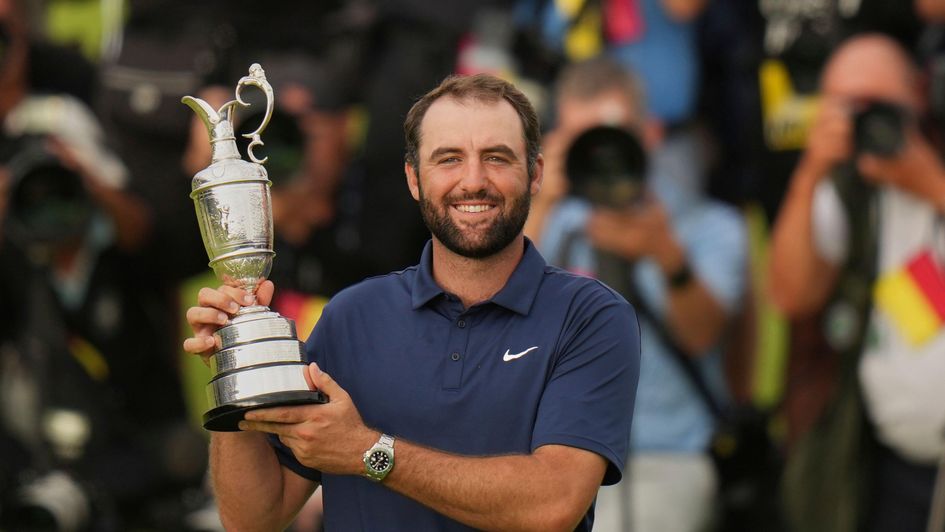
Sometimes in sport, you don't know what you're seeing when you're seeing it. Sometimes, you do. Right now we are witnessing greatness from Scheffler who, if he retired today, aged 29, would already rank among the best players ever to have picked up a club. He has two green jackets, countless titles on the PGA Tour, a gold medal and now, a Claret Jug. None of it has seemed especially complicated.
The Open Championship was meant to be the exception, because there are things here even he cannot control, yet from Thursday's finish Scheffler looked precisely as described by McIlroy: inevitable. He birdied holes 16 and 17 that day, turning a humdrum round into a fantastic one. He did it again on Friday. On Saturday, he didn't have to; birdie at the 16th, his third in a row, was more than enough to set the stage.
Sir Nick Faldo says his biggest strength is mental. Others, including swing aficionados and his peers, might say that it's his club-face control. This week in the Open, it was his putter. Next week it might be his chipping. Most of the time, he ticks along nicely off the tee, never missing in the wrong place, happily filling the space between the powerhouses and the fairway-finders.
If that all sounds a bit regimented, then it is, and that's why it's not considered sexy. There is nothing breathless or flamboyant; there is for the most part no jeopardy. There are shots to hit and nobody better equipped to hit them. Where precisely that ability comes from who really can say. Would he be as good if he was single and agnostic? No, probably not. Would he be as good if his feet didn't slip and slide? No, somehow, probably not.
Scheffler is what all great golfers before him have been: a unique and curious blend of moving parts that will never really make sense. Already, less than four years since he first won a PGA Tour title, the only questions left to answer relate to precisely where he will rank among the others. And what's especially incomprehensible about all of this is that first is not out of the question.