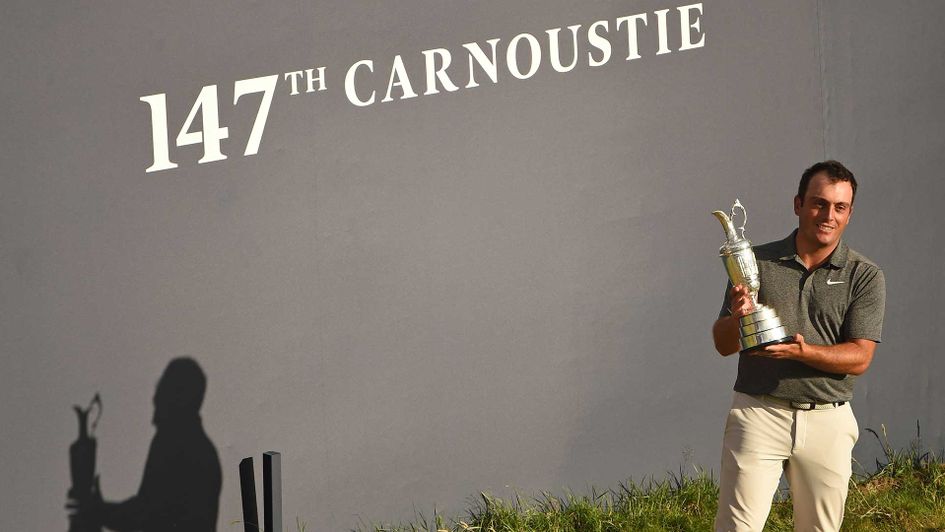
Ben Coley looks back on 2018 and the year's most notable performances, including the remarkable rise of Francesco Molinari.
The golfer who caught me by surprise this year was Francesco Molinari, and I'm sure I won't be alone in that.
As golf people debate distance, bifurcation and the perceived destruction of the sport's heritage through athleticism (and capitalism), everyone would appear to agree that power has become the most vital weapon in any arsenal. Molinari never had it. His approach relied on repeating the same, compact action over and over, which was enough to find the middle of the fairway and the heart of the green, but it's one which had ultimately been left behind.
Fortunately, his coach, Denis Pugh, has long been ahead of the curve. He understands more than most that to compete you need to be willing to accept certain truths, and so the pair set about adding a few extra yards to Molinari's game. As Molinari's compatriot Matteo Manassero will attest to, this represents a major gamble, and when for the first time in his entire career Molinari arrived at Wentworth without a top-10 finish to his name, it looked like he'd backed the wrong horse.
Then came the performance of his career, first to catch Rory McIlroy and then to fend him off without seeming to break sweat on Sunday. It was the first time we got to witness not just those extra 20 or 30 yards, but the benefits of intense short-game practice and a dramatically improved mindset. Not only did Molinari win, but he did so not in the manner of an underdog, but of an elite golfer doing what he expects to do.
"I think I showed today that I can do pretty much everything as good as the top guys in the world," the Italian said. Eight weeks later, when he produced a bogey-free weekend at Carnoustie to become Champion Golfer of the Year, he was well and truly proven correct. There may be no better demonstration of the value of patience, perseverance and refusal to plateau.
The making of a major champion
Patience and perseverance are enormous qualities, of course, but what did Molinari actually do - off the golf course - to become so successful on it?
I asked his coach to pinpoint the key steps along a road which led all the way to the Claret Jug at Carnoustie.
"The key to the year was missing the cut at The Players," Pugh said.
"The team were all down because the year had not got off to a good start despite having done some amazing work in the swing and in training.
"Francesco and I had a breakfast meeting at The Wisley and I stressed strongly that I thought he was doing the right things off the course and just needed to trust in the work he had done to add power.
"Basically, adding power sounds great for anyone and everyone but it also needs a mindset to take to the course in a power-play way, attacking at every 'sensible' opportunity.
"This is where the team came into its own and why Francesco was so hearfelt in his praise after winning the Open at Carnoustie.
"Trainer Rob Goldrup ensured his fitness gave maximum speed from his training whilst maintaining health, helping to stay injury free.
"Performance coach Dave Alred devised ever more demanding practice 'numbers' that proved his accuracy-power ratio could stand up to tour test.
"Phil Kenyon came on board as the final piece in the jigsaw. His job was not to make Francesco a great putter but to make him not a bad putter. I think the evidence showed how successful he has been in doing so.
"In today's power game you can't win with just great putting - but you can lose with poor putting.
And what of his own role? Typically, Pugh left that until the end.
"To make the swing free of all brakes - moves that actually stop the flow of power that Rob's training has given Francesco. My belief is a golf swing doesn't make power; it allows power to flow through it without brakes."
Molinari's success is another reminder that whether you're a golf fan, punter, writer, player... it pays not to try to pigeon hole; to allow yourself to change your mind and constantly reassess.
It's too easy to turn a golfer into a collection of numbers, rather than a beating-heart human with the capacity to grow, to change, all at their own unique rate. Some burst on the scene and then disappear, others are a slow burn and there are a thousand versions in-between.
Even as the game shifts towards younger, more athletic men than Molinari, he confirms that there is still room for something different; that those who hit 30 having not yet found their peak have another decade or more to get there.
It's a point worth remembering if you've decided that, at 23, Zander Lombard makes too many mistakes or if, at 30, Rickie Fowler just doesn't have what it takes to win a major or if, at 35, Kevin Na remains unreliable on Sundays or if, at 45, Lee Westwood's chances at the very highest level have without doubt disappeared for good.
I think the single most impressive thing I saw in 2018 was Matt Wallace's performance at the Made In Denmark.
To birdie the last three holes in regulation play and then add a couple more in the play-off, all with a Ryder Cup place potentially up for grabs, was just absurd. Clearly, Wallace is a winner, and it'll be interesting to see how far he can go. Tenacity is a wonderful asset in golf, but to join the game's elite requires a heck of a lot more, and we'll learn plenty about him in 2019.
There are any number of honourable mentions here: the way in which Brooks Koepka was unmoved by both a daunting clubhouse target at Shinnecock and the prospect of Tiger Woods hunting him down at Bellerive; the measured back-nine produced by Patrick Reed at Augusta; Molinari's golden summer and history-making Ryder Cup; Thomas Bjorn's planning and execution; Westwood's final round at the Nedbank; the spells Ian Poulter conjured in Houston.
The feelgood story of the year though is far easier to select: it simply has to be Charles Howell's victory in the RSM Classic.
Howell had gone years - 11 and change - since winning his second PGA Tour title, remaining a fixture on the circuit without gathering the silverware his talents merit. This was the player who was meant to serve it up to Tiger Woods owing to a game of such outstanding technical quality that he need not even be a natural born killer to become one of the world's best.
It's never quite that simple, of course, and when Howell opened the final round of at Sea Island with a bogey followed by a double-bogey, all that we had come to know about him remained true. Some are winners, some are not, and Howell was chairman of the latter society.
Then Howell rallied like never before. Perhaps he did so because he was freewheeling in a way which 54-hole leaders cannot, but whatever the case he deserves enormous credit for salvaging a winning chance - even in the face of one of the greatest weekends' golf in PGA Tour history from Patrick Rodgers. Birdies at the 15th, 16th and, most impressively, 17th holes helped earn Howell a play-off, before another sealed the most memorable of victories.
There may be some significance in just who Howell got the better of. When Rodgers arrived on the professional circuit, it was with a college record to rival Tiger's - both having attended Stanford - and a game which most expected would propel him quickly to the elite, side-by-side with Justin Thomas. So far, it hasn't quite happened and I wonder whether he might be the next Howell; the sort of player who is never far from brilliance but never quite reaching their potential.
As with Wallace, 2019 will tell us more about that, and there remains a chance that Rodgers turns one win into plenty. As for Howell, he'll return to his beloved Augusta at the Masters and while it's unlikely he's going to 'do a Molinari' now 39 going on 40, I suspect he's not done winning at three. If he is, securing the RSM Classic in his home state after all had looked lost would be a nice way for one of the nicest men in the sport to effectively bow out.
The stories I get most out of are those like Howell's and like Na's; the ones made by players that I can see have outstanding technical skill but demonstrate a fallibility within that I can more easily relate to.
The gap between Na's first win and his second was not quite as long as the gap between Howell's second and third, but at almost seven years he'd certainly paid his dues. In the end it was remarkably straightforward, six birdies in seven final-round holes ending the Greenbrier as a contest and allowing Na, clearly still terrified, to get his ball to the clubhouse without the sort of ruinous mistake that once gained him internet notoriety.
After came one of the most emotional winning interviews you will see, one in which Na thanked his Korean fans as well as those in America who had stood by him. The latter were few in number. Na can be an infuriating watch, taking an age to hit the ball, but to some - myself included - that only adds to his endearing charm. He's not so much going through a process as he is plucking up the courage.
I wrote at the Ryder Cup that Molinari's record-breaking performance was victory for David in a game of Goliaths. In a different way, Na's version of the same fable was no less impressive.
Speaking of the Ryder Cup, Le Golf National was the subject of much discussion before, during and after.
Students of golf course design will tell you that it's a poor golf course and I can fully understand the logic. Decision-making should be a key part of the sport and when it is removed, because the reward for hitting a certain club just isn't there, the spectacle suffers. The best holes are those which offer a safe route and a risky route and various options in-between, and that's why there's no outstanding hole on the layout.
Le Golf National is purely a test of execution but in Ryder Cup terms, we shouldn't underestimate the value of the design when it comes to the spectator experience. The Old Course at St Andrews might be holy turf, but watching golf there is not especially enjoyable. Le Golf National might be a man-made monstrosity to the absolute purist, but I've never had a clearer view of players and shots.
Measured that way, it was a resounding success. Even if by most accounts it was a nightmare to get to as a fan and, as a member of the media, I'd have preferred our bus drivers to have a working knowledge of the route to and from the course.
While I enjoy seeing golfers lose control of their emotions, it was remarkably impressive of Georgia Hall to avoid doing so as she strode to victory in the Ricoh Women's British Open.
There's been much said about Hall over the last week, largely relating to the BBC having basically snubbed her at their Sports Personality of the Year ceremony.
I am of the belief that they made a huge mistake, not least because they had earlier honoured Billie Jean King, a pioneer of women's tennis who did so much for equality, laying down the first slab on the long path to equal prize money at Wimbledon.
Hall's achievement in winning at Lytham was deserving of at least a dedicated section; I would like to have heard Dame Laura Davies reflecting on it, perhaps even Hall's dad, who was caddie, and certainly Hall herself. I see no reason they couldn't have asked Molinari or Tommy Fleetwood to talk about it, either.
Elephant in the room time: I do not write about women's golf. That's because I'm not an expert in it, and it's the same reason I don't write about seniors' golf. The BBC's job, on the other hand, is surely to champion all sporting success at an event designed to celebrate it and, on the night where much praise was given to the England netball team, they missed a trick by not making Hall a focal point.
It's ironic that Hall made the shortlist for Young Sports Personality of the Year in 2009. Less than a decade later, she has fulfilled the promise talked about then, and she's done so in a sport dominated by golfers from Asia and the United States.
Netball, which won two awards last Sunday, is thriving in this country. Given the right platform, Hall could inspire a new generation - boy and girl - to take up golf and build towards something similar, both having benefited from the commitment of Sky Sports.
It's a shame she was denied that opportunity in front of millions of TV viewers by the increasingly frustrating BBC.
There's much to look forward to in 2019, including the next chapter in Tiger Woods' remarkable story, a significantly revamped golfing calendar which condenses the majors into an intense April-to-July stretch, a Presidents Cup where Woods captains the USA against Ernie Els' international side, an Open Championship in Northern Ireland and the rise and rise of Cameron Champ, a game-changing golfer in the making.
I wonder how much of what happens in the majors we'll be able to trace back to 2018. If you rewind to the 2017 PGA Championship, won by Justin Thomas, you may recall that Molinari and Reed tied for second - they would, of course, go on to win majors in 2018.
Thomas himself had been favourite with 18 holes of the US Open to play just a couple of months before winning the PGA, and Koepka's three victories were preceded by a sequence of big performances as he quickly grew comfortable in the most important events on the calendar.
Not always is the trajectory so obvious, but don't be surprised if the latter months of 2018 prove prescient when it comes to the events of 2019. That bodes particularly well for Bryson DeChambeau and perhaps even Tony Finau, but be sure to keep an eye on Jon Rahm and Gary Woodland, too.
Rahm finished fourth despite putting poorly in the PGA, Woodland likewise in sixth, and I'm excited to see what they can do this year. Rahm has had no trouble collecting titles in his two full seasons as a professional and while it's been less straightforward for Woodland, the pieces might just be falling into place for one of those slow burners with the potential to win any tournament, anywhere.
As for my tipping in 2018, it's been a real mixed bag.
Andrew Landry's success in Texas, at 200/1 and to a full point each-way, resulted in the single biggest return since I began writing about this infuriating sport almost a decade ago. In the months leading up to it there had been Shubhankar Sharma's astonishing Sunday in Malaysia, George Coetzee's reliable performance at home and, in the very first event of the European Tour season, an ideal start thanks to Wade Ormsby and Alex Bjork in Hong Kong.
After Landry, however, it was a tale of frustration. It was, admittedly, extremely satisfying to be on Tiger Woods when he won again and pleasing, too, to capitalise on bookmakers too quickly dismissing Justin Thomas after a humdrum Open Championship for the second year running, but beyond those standout weeks there wasn't very much to shout about. And quite rightly, nobody seemed fussed about the QBE Classic.
It's important to self-assess and on reflection I spent too much time trying to look clever (*father nods knowingly*). You spend hours and hours researching, you find something that others might not have found, and you want to make a point about it. It's a painfully obvious weakness of mine and, while others were landing some smack-you-in-the-face winners, I frittered away profits trying to find the next Landry.
My other big failure this year was getting the favourites wrong on a regular basis. Whenever I sided with Rory McIlroy, he proved a major letdown; the same goes for Jordan Spieth and Dustin Johnson. I missed the penalty kicks, despite arguing that Sergio Garcia at Valderrama was a perfectly acceptable bet, and I played contrarian far too many times, backing an elite golfer at a big price despite obvious negatives. Live and learn.
Finally, and genuinely, thank you for reading. I'm fortunate that enough of you do to justify the hours spent. I'm grateful for all the emails and (most of the) tweets and apologise to those who caught me at a bad time.
Next year the aim is to launch a podcast which can compete with the many excellent ones already established, to write more things that aren't about betting but, mainly, to find a few more winners.
Merry Christmas and good luck for 2019.