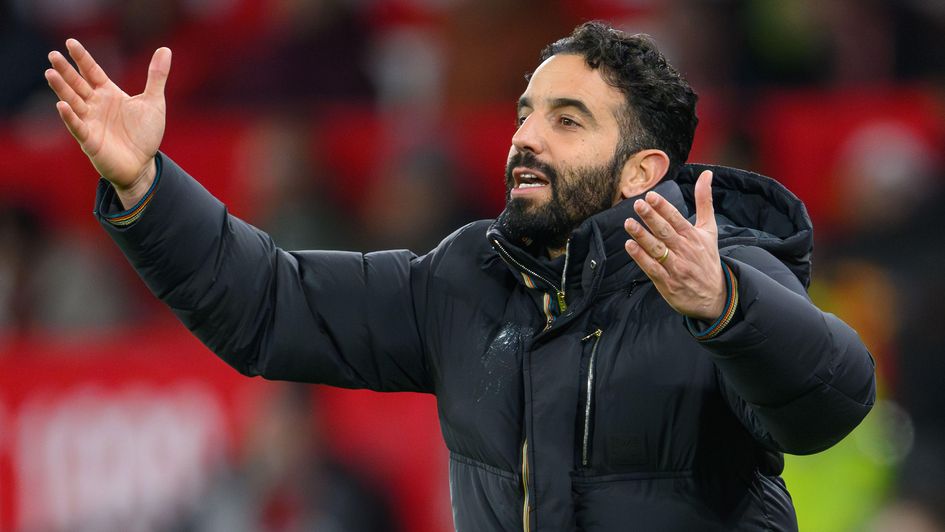
There it was, the moment everyone had been waiting for, fittingly buried beneath a game of circus-level carnage at Old Trafford.
- Published before Aston Villa 2-1 Man Utd
Ruben Amorim has abandoned the 3-4-3 formation. The result was a wild and maddening 90 minutes even by his high bar as Manchester United manager.
Like a politician carefully laying the groundwork for a costly U-turn, rumours of Amorim’s formation somehow made their way onto The Athletic website on the day of the 4-4 draw against Bournemouth, although actually seeing Amorim let go of his only non-negotiable – of the principle by which his tactical ideology was to be judged – was still pretty shocking.
So was the chaos that ensued. For the opening 70 minutes Man Utd hovered somewhere between their usual 3-4-3 and a 4-3-3, with Leny Yoro drifting so far into the right-back position that Gary Neville on Sky Sports co-commentary memorably called it a “secret back four”.
There was no secret in the final 20 minutes. Amorim put it up in neon lights with an extremely aggressive 4-2-4 formation that included so many attacking players two of them, Bryan Mbeumo and Benjamin Sesko, literally bumped into each other during the counter-attack that ended in Matheus Cunha’s strike for 4-3.
At this point Amorim could have switched back to 3-4-3 and put the brakes on to hold out for the win, which is why, for a manager acutely aware of the politics and the optics, it is worth pausing on Amorim’s decision not to revert to type. Instead he let the madness of the 4-2-4 play out, right through the Bournemouth equaliser and on into the dying seconds, when David Brooks missed two glorious chances to win the match.
Although it would be absurd to suggest Amorim didn’t want to win this match, there is some merit in theorising he wanted people to see how ridiculous and porous in defence four-at-the-back can be. Perhaps using a back four in such a kamikaze style was Amorim’s way of taking aim at those who thought losing the 3-4-3 is all it would take to solve United’s problems.
“We are not winning games [because of] the details,” he told Sky Sports after the game. “It is not [about] back three, back four, or back five.” Here was evidence, of a sort.
And Amorim does have a point. Pundits analyse the 3-4-3 formation as if they were talking about the rigid lines of table football, when in reality there is plenty of shape-shifting from within that structure. As defenders jump out to press and forwards drop back to build attacks, the formation often morphs into various different shapes, just as the modern 4-3-3 so often turns into a 3-2-5. As Pep Guardiola once said, formations are just telephone numbers.
But if we are overanalysing Amorim’s 3-4-3 or indeed his decision to renounce it on Monday, well, that’s his fault. It is unusual for a manager’s tactical system to be scrutinised so heavily by even the most casual of fans but holding dogmatically to a single idea for so long encourages that discussion and puts the manager in a trap of his own making. The longer he held to it the more his bloody-mindedness was blamed and the more concession to public demand would look like weakness; loss of control; the end of his authority over populism.
With that in mind the timing of the formation change also suggests politicking. Man Utd have lost one of their last ten matches and are just outside the Champions League places. Pressure upon Amorim has rarely felt lighter, allowing him to take ownership and authority of the call to implement a back four. He can fairly claim this was not forced upon him by outside noise; is not a desperate act to save his skin.
That will help his cause, but only a little, because there is no getting away from the fact that Amorim has crossed the Rubicon. When you deliberately headline your formation as the symbol of the project, you choose to live or die by it.
Moving forward from here will be more challenging than ever. Find success with the back four and it will throw the spotlight on Amorim’s previous stubbornness, risking indignation he did not switch earlier and inviting questions about his tactical chops. Continue with the 3-4-3 and, unless Man Utd hit form, calls for the back four will grow substantially louder. The red line has already been crossed. So why not cross it again?
United have enjoyed free midweeks this season but that all changes with a sequence of five matches in 19 days over Christmas, during which time Amad Diallo and Bryan Mbeumo will be away at AFCON. It was always going to be a tough few weeks, perhaps even a decisive period in a project that continues to teeter on the edge of crisis.
But now that the genie is out of the bottle Amorim has made the task a whole lot more difficult.
More from Sporting Life
- Fixtures, results and live scores
- Home of This Week's Acca
- Football and other sports tips
- Download the Sporting Life app
- Podcasts and video content
Safer gambling
We are committed in our support of safer gambling. Recommended bets are advised to over-18s and we strongly encourage readers to wager only what they can afford to lose.
If you are concerned about your gambling, please call the National Gambling Helpline / GamCare on 0808 8020 133.
Further support and information can be found at begambleaware.org and gamblingtherapy.org.