
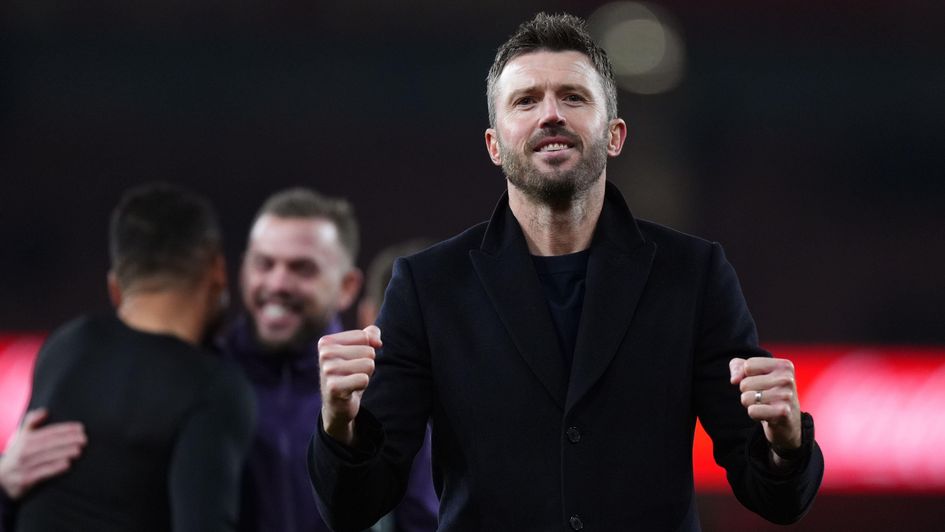
The sugar rush of the latest Manchester United news hits like a tidal wave and every single person interested in English football is grateful for it.
The Man Utd industrial complex has a compulsion to produce box-office entertainment.
A fortnight ago it was implausible that Michael Carrick’s interim tenure would produce anything particularly intoxicating. We would have to wait for a slow-motion burnout if this interlude was to feed us something juicy.
But two ridiculously good performances and two implausible wins against Arsenal and Manchester City have created hysteria of an equal and opposite proportion to the horror of Ruben Amorim’s final months.
There is just no stopping this thing. It will not slow down, it will not stop producing headlines.
Just when you thought United had swerved returning to the same old cycle by picking Carrick over Ole Gunnar Solskjaer, the new interim boss has, in two moves, plunged the club back into the halcyon days of 2018.
Michael is at the wheel and there is nothing you can do about it.
The thought of Carrick being given the full-time job already feels likely should he steer United into the Champions League, a distinct possibility in a season when they would only have to finish above either Chelsea or Liverpool, two rivals also in transition.
But it goes much deeper than that. Carrick simply looks the part, acts the part, and – this one’s new – plays a style of football that has instantly chimed with the Man Utd commentariat.
Friends (or rather, ex-team mates) in high places was helpful to Solskjaer but whereas he was eventually weighed down by a conservative tactical instinct Carrick has already impressed the ‘Class of 92’ pundits that litter our screens with a strategy that is, er, basically exactly the same.
What the Man Utd media conglomerate wants to see is the football they were coached to play by Sir Alex Ferguson, who held to a longstanding Old Trafford tradition for fast, wing-based attacking football.
But the decade that followed Ferguson’s retirement saw an unprecedented shift in tactical theory in English football and the revolution wiped our memories of what came before it.
The rise of Pep Guardiola and Jurgen Klopp made their defining principles – suffocating possession and constant high-pressing – synonymous with attacking football, warping our view of what Ferguson had been for Man Utd.
Seven years ago, when Solskjaer was in the hot seat, sitting in a conservative midblock to soak up pressure and then counter-attacking with a few sharp passes into the wings was seen as defensive.
It was not the ‘United Way’ – except that it was. It was exactly how Ferguson’s best Man Utd teams played, only the fashion at the time blinded us from that reality and made Solskjaer’s strategy unfit for the era.
When the game was defined by possession football, anyone who chose not to play that way was inevitably pushed into retreat, the territorial inferiority translating to fewer chances and bruised egos.
But we have left that phase now. English football has become looser, more transitional, and more set-piece dependent. All of a sudden falling behind the ball into a 4-4-2 does not signify low status, and just like that we are remembering what the Ferguson era stood for.
A throwaway line on a recent edition of the Gary Neville Podcast, recorded after Carrick’s debut hammering of Man City, was a telling reveal.
“You’ve just watched 90 minutes of… what I think this club plays like when it’s actually at its very best,” Gary Neville said in the middle of a monologue on Man Utd’s attacking traditions. “And that’s sometimes unashamedly being without the ball and just being behind the ball and saying, go on, knock us down. We’ll just counter-attack on you.”
That sentence would have been unthinkable a couple of years ago. But the subtle tactical shift happening in the Premier League has created space for counter-attacking football to be seen as something positive, progressive, Ferguson-esque.
It leaves Carrick with a very strong hand, although it also leaves him in the slightly surreal position of needing to beat Fulham at Old Trafford to show he is the real deal.
Counter-attacking sucker-punches have been a common feature of the modern Man Utd, pulled off by pretty much every head coach from Jose Mourinho onwards.
The real test is how Carrick approaches a run-of-the-mill home game in which his side are the clear favourites and must show it; the real test is whether he can breeze past an opponent as the dominant force, just like Ferguson did every single time – in our imagination, anyway.
Six of Ferguson’s 13 Premier League titles were won with 83 points or fewer, a total that means at least a third of all league games were drawn or lost.
But history doesn’t actually matter, only our perception of it. Carrick is expected to sweep past mid-table sides. If he manages that on Saturday then the clamour for his full-time appointment will begin.
More from Sporting Life
Safer gambling
We are committed in our support of safer gambling. Recommended bets are advised to over-18s and we strongly encourage readers to wager only what they can afford to lose.
If you are concerned about your gambling, please call the National Gambling Helpline / GamCare on 0808 8020 133.
Further support and information can be found at begambleaware.org and gamblingtherapy.org.