
Jurgen Klopp had a big decision to make heading into Liverpool’s Champions League clash with Ajax.
The Reds had been using a 4-4-2 system, a move that came about earlier this month as they looked to get back to basics.
It is too early to judge whether the switch has been a success but it has certainly had a positive impact on a number of players.
Mohamed Salah, marooned on the right earlier this season, looks more dangerous than ever in a two-man attack.
Darwin Nunez had three goals in his last three starts in this new shape while Roberto Firmino has rolled back the years this term.

Not only did all three have to start what was a must not lose game in Amsterdam, but they all had to start centrally, somehow.
Shoehorning Nunez onto the left flank, a role he had played for Benfica, would have nullified him due to the defensive responsibilities that are tied to the position.
Likewise, having Salah back on the right having seen the destruction he can cause centrally would’ve been making life easier for the opposition.
With his options limited due to injuries, Klopp switched up the shape yet again and went with a 4-4-2 diamond.
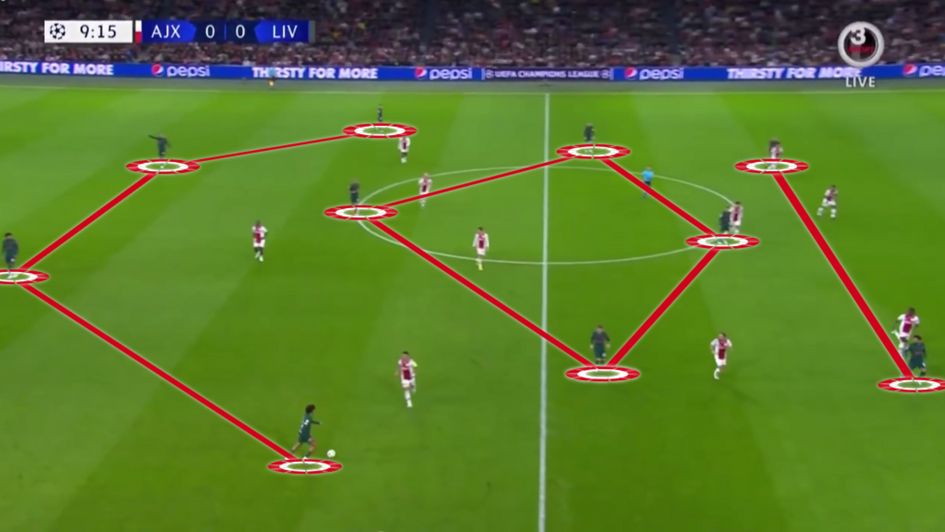
He explained his reasoning for it in his post-match interview: “We could have lined up with that formation in a 4-3-3 but we decided to go more for a diamond. The difference is not that big in possession but it keeps the strikers a bit more inside so we had no clear wingers and it opens up for the full-backs.
"You have to be really brave in the No.8 positions and the full-backs positions. The problem is you arrive in the challenge where you want to block the full-back and at that moment they pass to Tadic or Brobbey and there we couldn’t stop them. They were physically really there.”
It was a bold call.
The midfield make-up
The diamond shape is one that is precariously balanced. The deepest midfielder can be left isolated during transitions if the No8s are caught in advanced areas.
Teams can sometimes nullify themselves if full-backs, those tasked with creating the width in this shape, are unable to get forward due to the midfield balance being off.
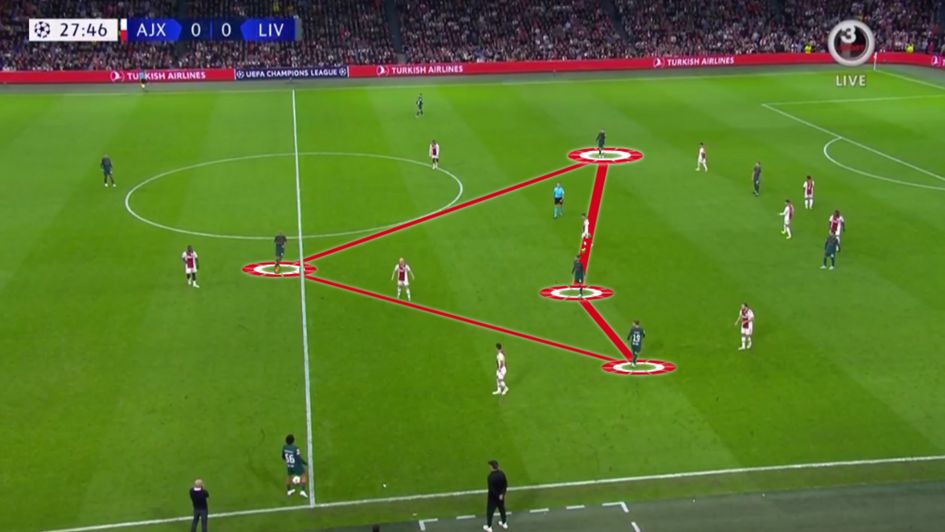
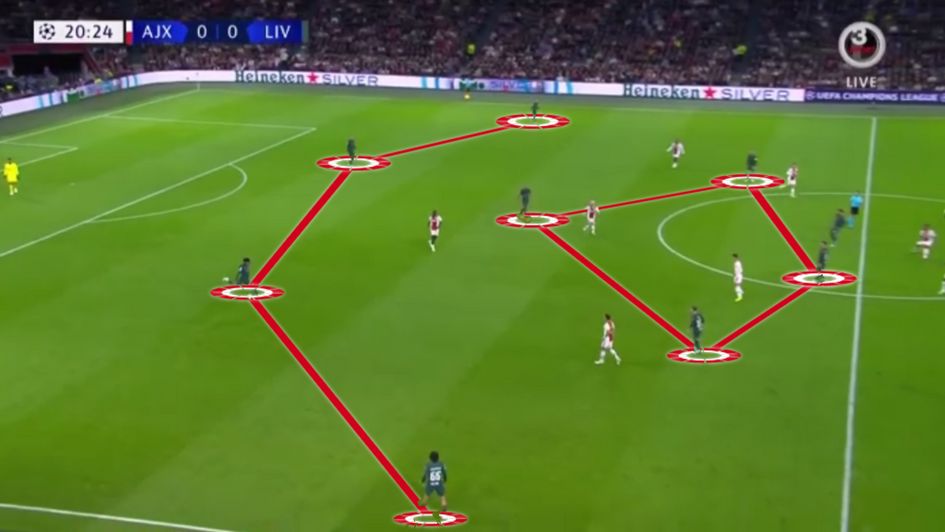
There was an example of this above. Trent Alexander-Arnold could play a big switch to Andrew Robertson but he’s reluctant to do so, perhaps due to the spacing of the midfield.
Henderson has stepped up to take a fairly aggressive position for a left-sided central midfielder, especially given the ball is on the opposite flank.
If Alexander-Arnold attempts a switch and gets it wrong, Ajax have a free run at Virgil Van Dijk with a lot of space to hit.
If the switch isn’t on, it condenses play as the Reds have to go back inside and Ajax can keep their shape.
That was happening a lot early on as Liverpool adapted to their new shape. Just before the 30-minute mark, the visitors seemed to click.
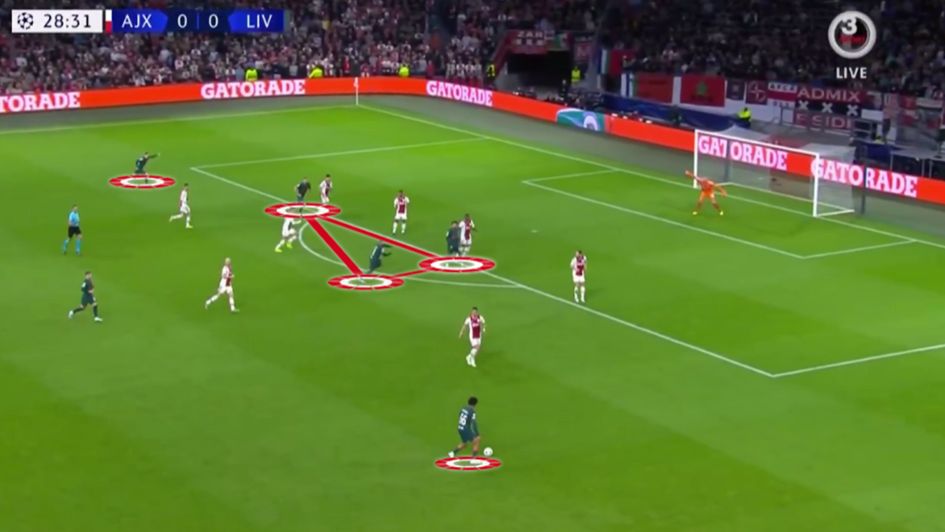
Henderson was holding his position on the left and allowing Robertson to overlap. The Reds not only started to get crosses into the area but they also had players in positions to pick up second balls to keep that pressure on.
Fabinho, for example, won 100% of his tackles, made two interceptions and won five of the six aerial duels he attempted. He was back to sweeping up and helping the Reds retain their position in the Ajax half.
It was what Klopp and Pep Lijnders would have had in mind when they drew up the idea for the new shape.
Diamonds are forever?
This is not the first time Liverpool have used a diamond under Klopp.
The German tactician deployed it early on in the 2018/19 season but it went a little under the radar.
“We are not that stubborn system-wise. We were never. We have already played a diamond this season and nobody spoke about it. Obviously, it wasn’t that obvious afterwards otherwise there’d have been big stories about it!
“We try to use players in the best way and give them the position where they can shine.”
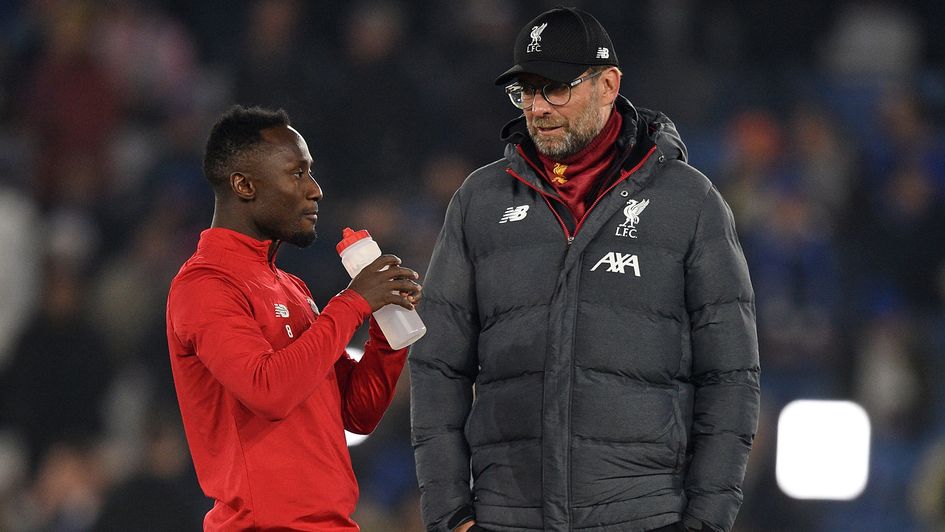
Back then, the tweak was to help new signing Naby Keita get into the swing of things. He had been used in a double pivot for RB Leipzig so the Reds had him doing the same for them, just with the added security of a No6 behind.
It allowed him to influence things in the offensive third, something the No8s weren’t tasked with at the time for Liverpool.
Firmino, used as the No10, would drop to help in the middle third and the space he created would be filled by Keita. It was prevalent in the 4-0 win over West Ham United on opening day.
This time around, Firmino’s selfless movement created space for Salah.
The Egypt international put on a real No9 clinic against Manchester City earlier in the month. Last night he showcased his varied skillset operating as a playmaker.
Liverpool seemed to have a clear plan in mind. Firmino would drop deep to involve himself in the build-up and Edson Alvarez would follow him. This opened up areas ahead of the Ajax defence.
Salah would then drop into those spaces and one of the centre-backs would be forced into tracking him. Nunez would play on the last line of the defence looking to get in behind.
In many ways, it was a classic little-and-large partnership, but the 6ft2" forward was one the one running off the shoulder of the defender. There is an example of it above as well as two others below.
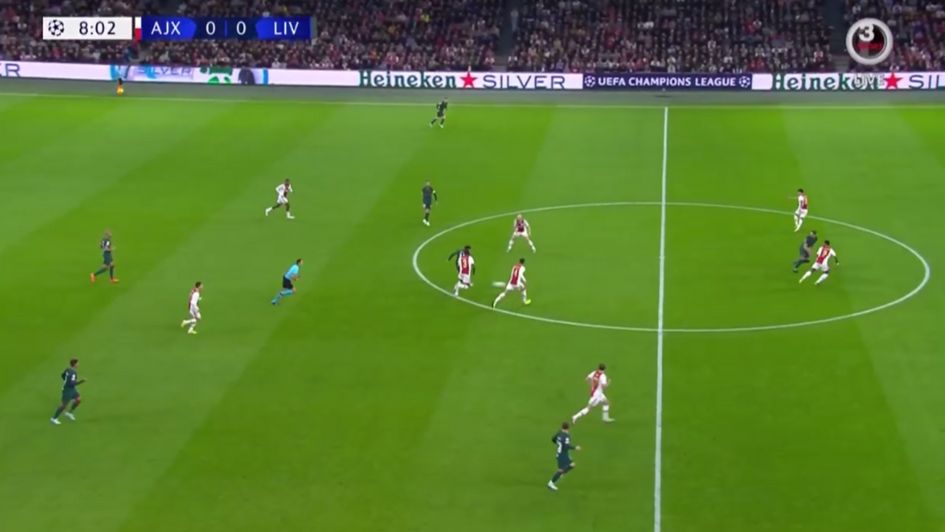
This situation comes about after Firmino had dropped to receive a pass from Alexander-Arnold.
He knocks it to Elliott who picks out the retreating Salah. Now, the No11 is manhandled by Calvin Bassey and it should’ve been a free-kick but after he manages to wriggle free, the referee plays on.
His attempted pass to Nunez is intercepted, but the idea was there for all to see. Liverpool wanted Salah in that pocket of space ahead of the centre-backs during the build-up.
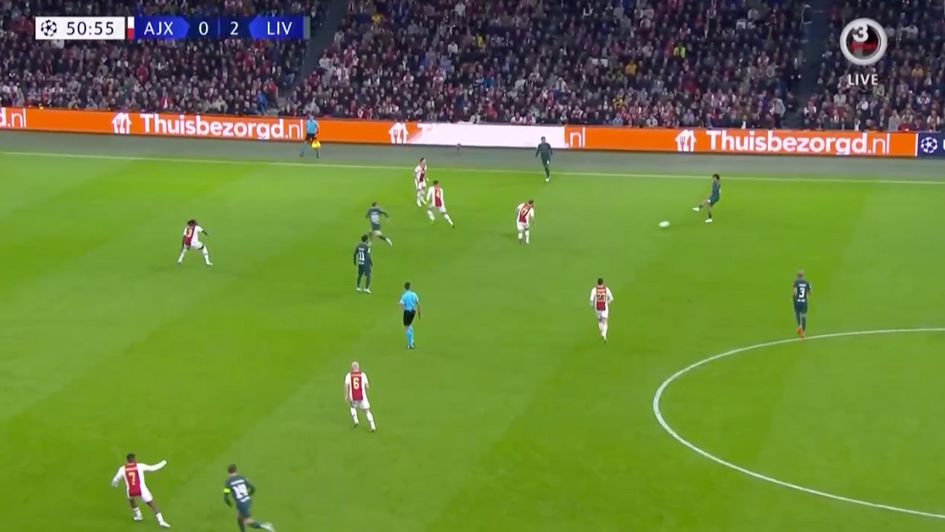
This is just prior to the third goal. Firmino occupies Daley Blind on the touchline and this forces Edson Alvarez into tracking Elliott. Salah just drops off the centre-backs and holds his position in the space seen above.
Bassey is caught in no man’s land. He can’t cover Eliott’s run as it would mean Salah is under no pressure but then he isn’t quick enough to get out to the No11.
The pass goes right by him as Elliott races into the space the Ajax centre-back left when he stepped out to press the ball.
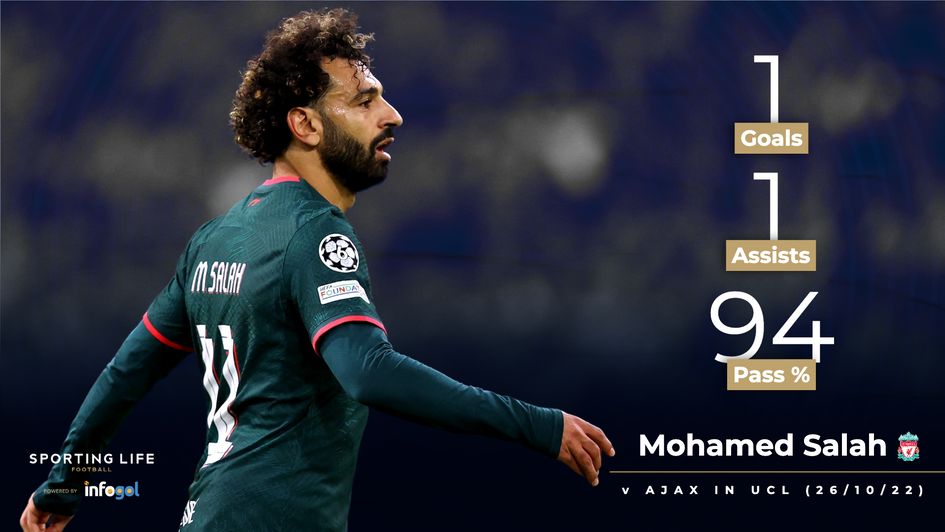
Salah looked comfortable in that role. He completed 94% of his passes, way up on his season average of 81% across all competitions.
Alexander-Arnold is another who had to adjust his game. He was a little more conservative in his positioning and appeared to focus much more on the defensive side of things.
He made a goal-saving block to prevent Dusan Tadic from opening the scoring while also winning 100% of his tackles on the night. He attempted slightly fewer passes than he’s averaged this season (58 down from 64) but his passing accuracy was up (83% from 76%).
The England international tailored his game to the system. He didn’t have to be the chief creator and instead focused on the defensive side of things, and it was probably one of his best performances of the season.
Is it the perfect system for everyone? Probably not. But Thiago would slot in. Diogo Jota would thrive in any of the front three positions and there is a case to be made that Luis Diaz might be better suited to popping up in central areas.
The shuttler No8 positions also play to the strengths of Alex Oxlade-Chamberlain and Naby Keita.
This doesn’t necessarily have to be a short-term solution for the Reds.