The group stage of the World Cup is over, the loss keenly felt on an eerily football-free day in the middle of the tournament.
75% of the World Cup is now behind us; only 16 matches remain in Russia.
The knock-out stages have a lot to live up to. The final set of group games were no less exciting than the first two, with Germany crashing out thanks to an heroic performance from South Korea and several nations – including Uruguay, Croatia, and Brazil – beginning to look like serious contenders to lift the trophy.
Team of the round – South Korea
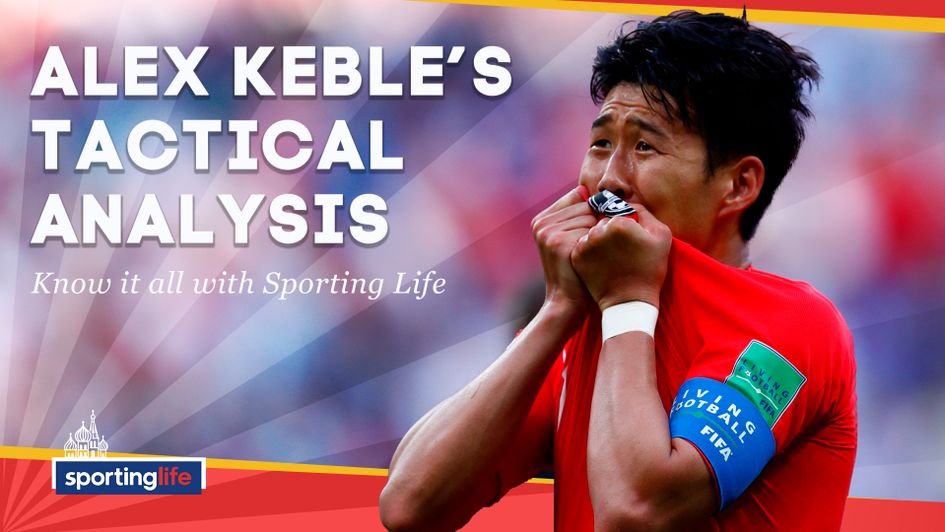
The biggest shock of the tournament so far has been Germany's premature exit, and it came in arguably the most exciting game of the 2018 World Cup. South Korea might have waited until the 91st minute to make the breakthrough but it was only poor decision-making in the final third that prevented them from scoring earlier.
They were exceptional in carrying out their Mexico-esque game plan, showing great tactical organisation, bravery, and some heroic defending to expose Germany's flaws. Joachim Low's side were once again incapable of screening the defence (Sami Khedira returned to the side and was totally ineffective) while the full-backs happily poured forward, leaving huge gaps in behind for South Korea to counter into.
It came as no surprise, then, that Shin Tae-yong's side sat deep, absorbed pressure, and then pounced forward. Yun Young-Sun, Lee Yong, and Kim Young-Gwon were outstanding at the back, mopping up everything and calmly distributing for the breakaway, but surely the biggest hero was goalkeeper Hyun-woo Cho. His agent will be fielding calls next week.
Manager of the round – Oscar Tabarez
Uruguay had struggled to find fluency in their first two group games of the World Cup, failing to provide evidence that Oscar Tabarez had transformed them into a more possession-centric, controlling side. Rodrigo Bentancur, the graceful midfield player behind the evolution, wasn't exactly dominant against Egypt or Saudi Arabia.
The main reason for this was Uruguay's flat 4-4-2 formation, which didn't provide enough depth for a wide variety of passing angles through midfield. In straight lines, and with Edinson Cavani and Luis Suarez both preferring to play on the shoulder of the last defender, vertical movement was a problem for the South American side.
Consequently Tabarez deserves credit for the switch to a diamond 4-4-2 that included all four of his talented ball-playing central midfielders: Bentancur, Lucas Torreira, Matias Vecino, and Nahitan Nandez. Russia were overwhelmed in central areas; a similar pattern can be expected when they take on Portugal's two-man midfield. Uruguay have discovered the formation that can get the best out of their core strengths.
Partnership of the round – Ever Banega & Lionel Messi
Argentina's 2-1 victory over Nigeria wasn't a performance to inspire fresh optimism regarding Jorge Sampaoli's team, but they did at least find a formation and basic structure that might be enough to get them past France and into the quarter-finals. There were serious issues all over the pitch for Argentina, but in a 4-3-3 formation the partnership of Ever Banega and Lionel Messi was a highlight.
Messi played on the right wing, largely drifting inside into the half spaces in order to escape the opposition full-back. This is a much better position for Messi at the World Cup, where opponents can too easily surround him in central attacking midfield. Against Nigeria, pressure – and attention – was taken off him by the creativity of Banega.
The Sevilla playmaker was outstanding in the first half, dictating the game with his incisive passing and forward-thinking intent: two things that were conspicuously absent in Argentina's games against Iceland and Croatia. Benega's brilliant through ball for Messi's opener made for one of the goals of the tournament – and confirmed that the nation's hopes rest on the interplay of these two.
Player of the round – Milan Badelj
Hype is gradually building around Croatia, who were one of just three nations to win all of their group matches in Russia. Luka Modric and Ivan Rakitic have been excellent controlling the midfield so far, but Zlatko Dalic has struggled to find a defensive midfielder to partner these two, using a different player in all three matches.
In Milan Badelj, he has surely found the definitive answer. The 29-year-old Fiorentina midfielder was outstanding against Iceland, scoring one goal and assisting another while completing more defensive actions (three tackles, five interceptions, and two clearances) than any other player on the pitch.
Croatia now boast arguably the best midfield in the competition, certainly in terms of how the three players complement one another, although only time will tell if Croatia are capable of adapting from a dominant style in the groups to a more conservative approach in the knockout rounds.
Follow Sporting Life on social media - find us on Facebook here or tweet @SportingLife
Related World Cup links
- World Cup outright tips
- World Cup Golden Boot tips
- World Cup fixtures & schedule
- World Cup groups & predictions
- World Cup team profiles
- World Cup best bets
- World Cup Golden Boot contenders
- World Cup Golden Ball contenders
- World Cup Golden Glove contenders
- New world champions in Russia?
- World Cup venues in focus
- Full World Cup squad lists
- More free football tips
- Sky Bet's World Cup odds