


< Return to Betting Guide For Beginners Go to Betting Terminology Explained >
Latest Betting Offers



When it comes to odds or prices offered by bookmakers there are three distinct ways in which those odds can be displayed. These are referred to as fractional, decimal and moneyline, with the latter often being called American (and a lot rarer in the UK).
Having an understanding of how to convert between the two primary UK methods can be useful for ensuring you full understand the potential return from a bet. Using a conversion table can be useful to help with learning and more complex odds, but most UK bookmakers will allow you to choose between decimal or fractional odds in the account settings.
Likewise, you can also get a grip on the concept of ‘implied probability’ when assessing odds and shopping for value in the market. We will cover implied probability at the bottom of this page.
The table below gives you some common prices in the three formats.
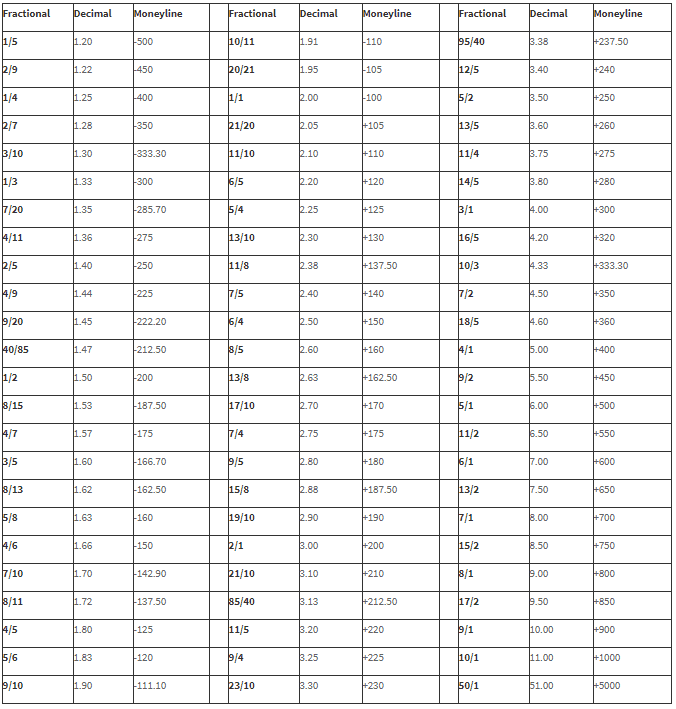
In the UK and Ireland, fractional odds are by far the most familiar and common. These odds are displayed as 1/2, 1/1 (evens), 2/1, 100/1 and so on. For European bookmakers, the most common format is decimal, where a price such as 3.00 represents the equivalent of the 2/1 fractional price. In decimal prices the returned stake in a successful bet is ‘built into’ the odds.
Meanwhile, in America, in the moneyline format if the figure quoted is positive it expresses the profit you would make from a successful bet with a $100 stake, so +200 means $200 in winnings on top of the returned $100 stake. A +200 moneyline price is therefore the same as the fractional 2/1 odds, or 3.00 in decimals.
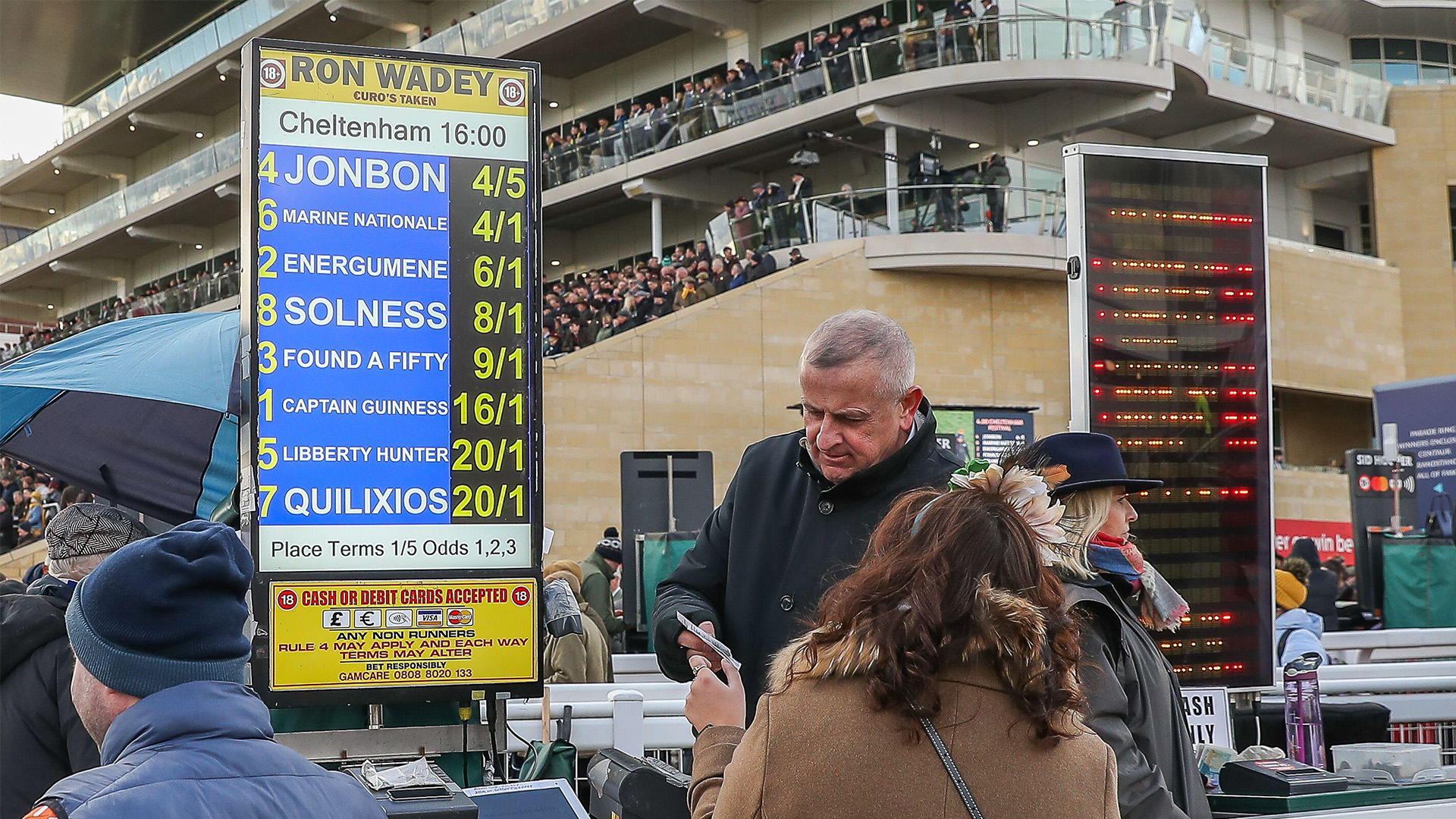
With origins in horse racing, fractional odds are by far the most dominant format to express prices in the UK & Ireland. However decimal odds are becoming more popular with new bettors as they are easier to understand for those new to the environment.
Fractions are easy to understand once you are used to them, with the most confusing fractional prices those closer to even money.Fractional odds express the profit the bettor will make against their stake, if their bet is correct. So with a 3/1 price if a punter puts down a £10 stake the potential profit is £30 (£10 x 3) and the total that would be returned is £40 (£30 profit plus the £10 returned stake). The same 3/1 price in decimal format would be 4.00 and in the American / moneyline format it would be +300.
When you see prices such as 9/2, 6/5 or 2/7 it can take a bit longer to understand your returns compared to odds that are 'to one' (e.g., x/1). With a £10 stake in a successful bet at a price of 9/2 the returns would be £55, a £45 profit plus the £10 stake back. A 9/2 price in decimals is 5.50 and in moneyline it’s +450.
6/5 is a slightly bigger price than even money (1/1) and is expressed as 2.20 in decimal format or +120 in American format. If you placed a £10 bet on a 6/5 selection you would get a return of £22 (£12 profit) on a winning bet.
2/7 is an odds against price, meaning there is quite a high probability of winning according to the bookmaker and if ti wins you are going to make a much smaller profit. A successful £10 bet at 2/7 returns £2.86 on top of the stake, so total returns of £12.86. This a 1.286 decimal odds price or -350 in American format.
The most popular format outside the UK and Ireland, prices in decimals tell you what you stand to win if your bet is a successful one, including the stake being returned to you. Sometimes decimal prices are quoted to three decimal places, so if you place a £10 stake at 4.755 your total return on a correct bet is exactly £47.55, meaning you made a £37.55 profit.
Although it takes a while to adjust from thinking in fractional odds to decimals they are becoming increasingly popular as they are easy to understand and accurately convey to the punter the exact return they stand to walk away with if their selection comes in. Decimal odds are also frequently used on betting exchanges.
Follow the patterns of typical decimals odds such as 4.00 (3/1 or +300), 4.50 (7/2 or +350), 5.00 (4/1 or +400), 5.50 (9/2 or +450) and 6.00 (5/1 or +500) and you soon get a feel for how they translate into fractional or moneyline prices. When using decimal odds, you simply multiply your stake by the decimal odds and you will know exactly the return of a winning bet.
As you might guess from the name this format is most popular in North America. Again, if the moneyline figure is positive it tells you what you can win on a successful bet with a £100 stake. Remember though, -100 is evens, so your returns are exactly double what you put down. A £100 bet at a price of -100 returns £200, or £100 profit. You bet £100 and you win £100.
With any negative moneyline figure beyond -100 the price is odds against and you stand to make less profit than the stake amount. With -105 moneyline (decimal 1.952 / fractional 20/21) odds your successful bet with a £100 stake win you £95.20 and so you walk away with £195.20 returns. With a -500 price (1.20 decimal or 1/5 fractional) your successful bet with a £100 stake gives you a £20 profit, so £120 total returns. Also, to note, sometimes you will hear prices or odds in North America referred to as ‘lines’.
Punters usually only find themselves in situations where they are trying to convert odds between formats, for example whilst on holiday or traveling and betting outside their home countries. It is useful to be able to do, if you don’t have a conversion table or tool to hand.
Converting decimal odds to fractional, take the decimal and subtract 1.00, so 5.00 – 1.00 = 4/1. However, if the decmial odds do not end in .00 then you will have to multiply the fraction to reach a non-decimal one. For example, 4.50 - 1.00 = 3.5/1, multiplied out to be 7/2 which is a normal odds presentation.
For converting moneyline to decimal, when the moneyline price is positive divide it by 100 and add 1. So, 300 ÷ 100 + 1 = 4.00. Or for example, 5000 ÷ 100 + 1 = 51.00. When the moneyline price is negative, take 100 and divide it by the moneyline amount (first removing the minus sign), and add 1. So for a -400 price it would be 100 ÷ 400 + 1 = 1.25.
For conversion of fractional odds to decimal take the first figure and divide it by the second figure then add 1.00. So 1/2 becomes (1 ÷ 2) + 1.00 = 1.50. Or 2/1 becomes (2 ÷ 1) + 1.00 = 3.00.
The concept of implied probability is worth keeping in mind when you try to assess the value of odds from a bookmaker. The odds are set based on the implied probability of the outcome, such as a horse winning a race, or a football player scoring a goal.
A 9/1 (10.00 or +900) bet is ‘expected’ to be successful once in every 10 occasions, so the probability would be 10%. A 1/4 (1.25 or -400) bet would be expected to be successful in four of every five attempts, it is heavily ‘odds on’ and the implied probability is 80%.
You can make these types of calculation to assess the % chance you think your selection has of achieving the result you are betting on and see if you feel the odds are giving you enough value to make the bet.


The No.1 place for Sports Betting Insight, Data & Content.
Browse our catalogue of sports free bets and betting offers.