


Can defence beat attack in the Open Championship? How long before someone shoots 61 in a men's major? Ben Coley analyses Friday's play at Birkdale.
Paying the penalty
Now, the remainder of this feature was published at about 8pm, but two hours later the drama which followed Bryson DeChambeau's brilliant second round demands that we revisit.
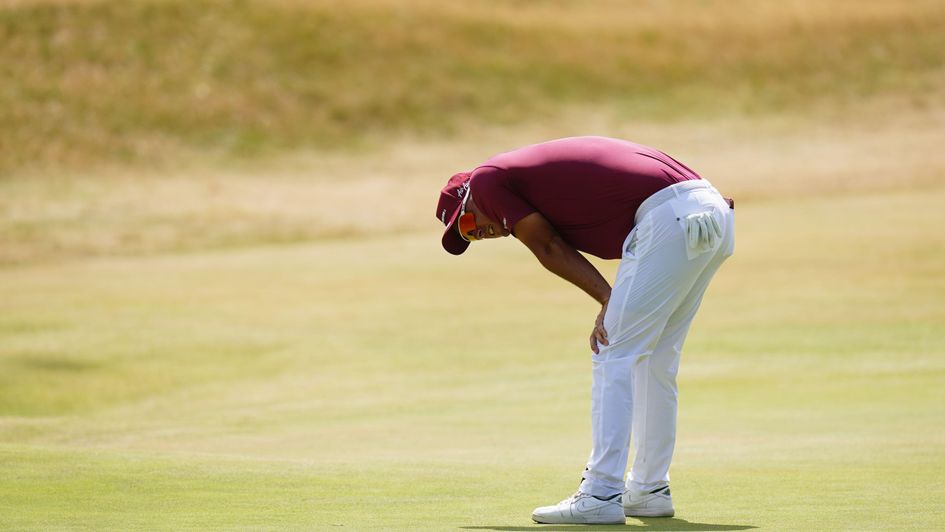
For those who turned off the coverage when the golf ended and/or are not chronically online, DeChambeau was driven out to the fifth hole by officials where, about five hours earlier, he had seemingly trampled down grass behind his ball while weighing up his second shot.
By 'improving the area of his swing', DeChambeau incurred a two-shot penalty under rule 8.1 (me neither) which saw him drop from second to fifth. That means he's no longer favourite and no longer in the final group despite a fabulous finish to his round.
"Bryson has been penalised two strokes for inadvertently improving the area of his intended swing," said R&A referee Grant Moir, before going into a bit more detail about why the rule in his view was broken, all this after a heated debate with DeChambeau at the scene of the crime. Well, not crime. You know. The trampling.
According to Kevin Van Valkenburg of The Fried Egg, DeChambeau's agent subsequently said: "He’s a lot of things. He’s not a cheater." That though is not the accusation. The R&A could not have been more equivocal in their statement. DeChambeau is not accused of cheating, he is adjudged to have broken a rule without intent.
DeChambeau hinted that he wouldn't come back for Saturday's third round, which lip-readers picked up on him saying while strongly arguing his case. But he was hitting balls late into the evening. He will play. It would be pathetic not to and, to borrow his agent's language, Bryson is many things. He is not a quitter.
As for a takeaway, the head-on video leaves little room for doubt as far as this individual decision goes. The problem is that Wyndham Clark appeared to have done something similar on his way to a one-shot US Open win. And that players across tours all over the world will break rules like this at some stage in their careers, often unpunished. This only came to light due to camera footage. Not everyone is followed by those.
Does that mean rules should be overlooked in the interests of some sort of balance? No. If a police car catches someone speeding, it is not a defence for the driver to state that someone overtook them a mile back. But DeChambeau is undoubtedly unfortunate, that is assuming he broke the rule with absolutely no intention.
On that, I'll leave others to decide. Meanwhile, we'll see whether DeChambeau can ride a wave of perceived injustice all the way to a Claret Jug, which would make for a rare thing indeed: a trophy presentation everyone wants to watch.
International men of mystery
Lucas Herbert produced one of the finest rounds of Open Championship golf in history, and the most significant from an international player since Cameron Smith won the Open four years ago. Maybe, at last, there's going to be something to cheer for fans from Australia, and some evidence of life from the international crowd.
From 2000-2015, there were 17 major winners from outside of the USA and Europe. In fact, only in 2014 did an entire season pass without one. Champions emerged from Fiji, South Africa, Canada, Argentina, South Korea, Australia, and New Zealand, several of them winning more than once.
Since the beginning of the 2016 season, only Hideki Matsuyama and Smith have added to that tally. South American golf seemingly hasn't advanced, Joaquin Niemann yet to prove a genuine major force. Australia has relied on Adam Scott for a consistent presence, Min Woo Lee still too raw to compete regularly. South Africa was left with a void behind Charl Schwartzel and Louis Oosthuizen which is yet to be filled.
Ryo Hisatsune and Keita Nakajima are promising but neither is an obvious pretender to the Matsuyama throne. Perhaps Jayden Schaper and his fellow young South Africans can go on to prove world-class, but the level reached even by Schwartzel and Oosthuizen, never mind Ernie Els, for now looks out of reach. Min Woo has time, so does Niemann, and they're both proven at something close to the highest level. There are also a handful of promising amateurs to watch including one from Bolivia.
But the present could do with an international contender, particularly in an event like the Open Championship, where the flags of represented nationalities fly proudly atop the grandstand. Second in an alphabetical line is that of Australia. Thanks to Herbert's scintillating 62, it sits first on the leaderboard. About time too.
New record on ice
Herbert of course will have left Birkdale with a bittersweet feeling given the way his round ended. From the middle of the fairway at the par-five 17th, iron in hand, a 4-4 finish would've given him a round of 60. Instead, nine more shots were required to make it 5-5 but it's the penultimate one that will sting. Five feet between Herbert and history, he pulled the putt.
It meant that Branden Grace's 62 from 2017 had been matched for a fifth time since, but that became six within minutes, as Sam Burns birdied the final three holes to complete a back-nine 30 and shoot the same number. Burns hadn't been expecting to play in the Open, but his newborn baby arrived safely and ahead of time. He hopped on a plane and, days later, joined what for now is an exclusive club.
There's at least a chance this club doesn't mean much in a year's time, when the Open goes to St Andrews. The Old Course is vulnerable to the way the game is now played and while 63 remains the Open record there, another warm summer combined with relatively little breeze (some wind sometimes helps at the Old Course) could lead to something lower. If not there then perhaps at Royal Lytham the following year. One way or another, from zero to six rounds of 62 or lower in less than a decade represents an inevitable trajectory.
What to make of all this is difficult and, like Herbert making his way to his accommodation, I have mixed feelings. Deep admiration for these modern athletes, their skill and dedication, yes. But sadness, too, for the way that modern equipment has been allowed to ride roughshod over what was once a much more nuanced, subtle, and downright beautiful game.
Herbert smashed his driver down 17 and 18, as he's well entitled to do, but the final drive in particular left me wondering about what it was like to watch the Open in the 1970s. Nobody then would've dared attack the ball like that. We can talk about their relative lack of athletic prowess versus today's stars, doubtless a significant factor, but the equipment they were working with has to have been the primary one.
The sort of high, spinning, left-to-right drive Herbert struck 320 yards down the 18th hole would've gone 50 yards shorter and 20 yards further to the right, where there's an out-of-bounds fence, in another time. Again, this is no criticism of the player, making the most of the tools as his disposal, just as Cameron Young did soon after, his drive sailing 348 yards down a supposedly tough hole. It's just a real pity the sport has been made less colourful. And, it seems, there's no turning back.
The weather gods
In the end, there really was no draw bias over the first two rounds of the Open.
Talk earlier in the week was that starting early on Thursday might just be advantageous and, for much of the first day, it looked to be. But after a breezy period around lunchtime, by the time dinner was being prepared the wind had died down. The difference in scoring favoured the first wave, but only negligibly, by less than a stroke.
On Friday, those players were paid back. There was cloud cover early and no wind, meaning the greens couldn't firm up and players were able to get on the front foot. As the clouds parted, still there was no wind, until it arrived at around the same time as the previous day. Once the scores had been added up, the margin from one side to the other was too small to be considered anything but noise.
It's worth saying, though, that this Open has reaffirmed my view that there are two good draws when all's fair: very early and very late. If you're out very early on either day, you tend to get a good crack at a softer course, often with less wind. If you're out very late, there's a good chance that conditions will somewhat resemble those of the early morning.
Both these draws come at a price: you tee-off either very early in the afternoon, or mid-morning, for your other round. Ultimately, this is about navigating all the different obstacles an outdoor sport can throw at you. Players will all agree that the weather left them with no excuses on that front.
One in the hand
As the likes of Scottie Scheffler, Tommy Fleetwood and Jon Rahm began their third rounds, Cameron Young and Sam Burns were chalked up at 15/2 and 14/1 respectively. Safely in the clubhouse, Young all but assured of a place in Saturday's penultimate group and Burns at worst the one behind, these two were surely being underestimated based on a false assumption: that the world's best would overcome a test made to look easier than it actually is by Burns and Herbert.
When Rahm made his first birdie, at the second, some bookmakers made him the same price as Burns. Rahm trailed the American by three shots. That would mean to match him by day's end, Rahm would need to shoot four-under. At the time, that represented the third-best round of the day. An 'Expected Score' for Rahm, to paraphrase Expected Goals, would've been about level, based on the scoring conditions and his ability. He managed to just about beat that without ever getting close to Burns.
Earlier in the week, someone commented about their best ever bet being Haotong Li for a top-five finish and in the 'without' markets here in 2017, after his closing 63. A former colleague once backed Tommy Gainey to win the RSM Classic at a whopping price after his final round posted a serious target nobody could match. I recall William Mouw being a big price when he finished his round at the ISCO Championship last year and he didn't have to hit another shot to win his first PGA Tour title.
The message is this: in an age of data, models and projections, one thing in particular still feels off, and that's how rounds in the clubhouse are rated. As a broad rule, they're often undervalued. It's just that people tend to like the possibility which comes with being out on the course, able to advance a score. Even when doing so is self-evidently difficult.
Attack versus defence
Robert MacIntyre gave beleaguered followers of these pages something to cheer with a stunning eagle at the 17th hole and had the round ended there, it would've been one the Scot could take enormous pride in. He played 16 holes in level par without a real birdie chance, so clearly not at his best, but a bit of fortune and a keen sense of timing saw him vault into fourth place with one hole remaining.
But then we saw him stick to his defensive game plan at the 18th and it cost him. At the same hole where Young had less than 150 yards remaining with his approach shot, MacIntyre was outside of 260. That's an enormous handicap and while he's not quite capable of launching drives to the moon and back like the American, MacIntyre's best club all year has been driver. He should've backed himself to thread the needle.
Instead, for the second day running he was playing with one hand tied behind his back and with the rough far from punishing, I think he has this wrong. Yes, he's playing to avoid fairway bunkers, but as Collin Morikawa had earlier shown, there's a killer bunker for those scaling back from that tee anyway. Watching MacIntyre hit hybrid after Young had hit wedge was jarring and I'm not sure he can win this playing as he has so far.
'You must play boldly to win' is the famous Arnold Palmer phrase we often hear and it's applied at all three majors this year. Rory McIlroy knows nothing else, Aaron Rai remained aggressive all the way to the line, and Wyndham Clark never once shirked the challenge. Watching Herbert throw everything at it, Jackson Suber run putts past the hole and Young fire driver wherever he could, it felt like they were the ones rising to the challenge.
Crude calculations reveal that Young's total driving distance came in at 4,251 yards, Herbert's at 4,109, up significantly on Thursday. MacIntyre's was 3,753. The top two in the betting both gained a stroke off the tee on Friday and ranked among the top 25 in the field; MacIntyre was worse than average and outside the top 80. That's currently the difference between being in the chasing pack and in the penultimate group. And it could be the difference between mounting a challenge and failing to.
A firm and fast weekend may yet prove MacIntyre's plan to be the right one, but as a fan of his, I hope it changes. At the very least, hitting his approach shot to the final hole from so far back requires a rethink. After England's meek exit from the World Cup on Wednesday, the idea of watching someone try to win with defence only to lose out to attack fills me with dread.