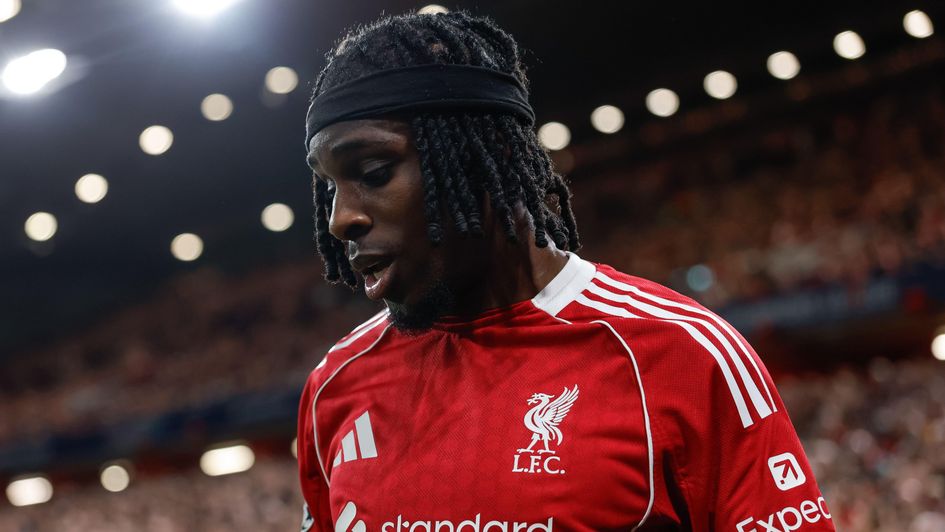
Some players are plug-and-play ones. They can do a job in pretty much any situation or scenario. Others require the perfect storm. If you sign a specialist in a certain position, you need to recreate the environment they initially thrived in to get value for your money.
Liverpool’s decision to bring in Jeremie Frimpong to replace Trent Alexander-Arnold raised a few eyebrows. The former Celtic full-back had impressed for Bayer Leverkusen in a very specific role.
Yes, he had value to the Reds as a homegrown player and yes, in theory, he could fill in across a number of roles. But the 25-year-old thrived for B04 in a position essentially shaped around him as a player.
He was a wing-back in the Xabi Alonso system who operated almost as a winger. However, he wasn’t burdened by offensive output. If he contributed in the final third with a goal or an assist, it was a bonus.
He was there as an outlet. He was a weapon for the 2023/24 Bundesliga champions when he was able to join play a little later. It removed the focus on his technical abilities and made it all about his physical traits.
Frimpong could overlap as well as underlap. The point was he was rarely picking the ball up with his back to goal. He’d be the one receiving a pass before bursting forward. His acceleration alone made it easier for him to bypass opponents and either hit the space or carve out space.
He was the complete opposition of Alexander-Arnold. For this signing to make sense, the team would have to adapt to Frimpong. That isn’t to say they needed to shape everything around the No30. But if they wanted to make the most of having someone with his profile, they needed to play to his strengths.
It’s safe to say this hasn’t happened.
The Dutch international, whenever he’s been fit, has been used primarily as a right-winger. Over recent weeks, with Mohamed Salah ruled out, Arne Slot has opted to use Frimpong in attack with Curtis Jones filling in at right-back.
He’s struggled to impact the game.
In the loss to Manchester United, the £30million signing had the joint-most touches in the opposition box but failed to have a shot or create a chance. He also failed to complete a single dribble at Old Trafford and won just 20% of his duels.
Yes, he finished with a 94% pass success rate but just three of his attempted passes went forward. He was a non-entity in the attack.
It was the same story against Chelsea last time out.
He had the joint-most touches in the box but finished with one shot, zero chances created, zero successful dribbles and he came out on top in five of his 12 duels.
Being a right-winger is completely different to playing almost as a right-winger. At Leverkusen, Frimpong wasn’t tasked with receiving the ball with his back to goal. He wasn’t tasked with facing a left-back. He wasn’t picking up possession in the final third and having to come up with something.
Instead, he was running onto the ball. He was usually getting an advantage over a retreating attacker or running off of the back of a midfielder. Frimpong was the final phase player. He’d join play late and get the ball into the box from a favourable scenario.
Across the Bundesliga last term, he ranked third for crosses in open-play with 94. He often picked up possession in a bit of space, after Leverkusen had gone back to front fairly quickly, and he was able to impact play.
Liverpool don’t move the ball quickly. It’s low. It’s easy for the opposition. It’s difficult for Frimpong. The Dutchman is very much a less is more type individual.
Technically, he isn’t brilliant. He wants to square up an opponent and beat him with pace before putting the ball into the box. The fewer the touches for him, the better.
There are parallels, in some ways, to the signing of Nathaniel Clyne. His performances for Southampton earned him a move to Liverpool. The more of the ball he had, the worse he looked though. He wasn’t a bad full-back, he just wasn’t a player who thrived when seeing a lot of the ball, but in a possession-based team, he wasn’t going to be seeing more of the ball.
Frimpong averaged 50 touches per 90 in his final season for Leverkusen. For context, Alexander-Arnold averaged 88 for Liverpool. Unless there was a huge tweak to the team’s style, Frimpong was going to have to scale his on-ball actions to fit in.
And he has scaled them. He’s now averaging 63 touches per 90 and this data will be a little skewed given he’s played different positions for the champions. Despite averaging significantly more touches, his output has dropped.
His expected goals (xG) average has dropped from 0.16 per 90 to 0.04 while his expected assists (xA) average has taken a hit, dropping to 0.13 per 90 from 0.18.
Combined, his expected goal contribution has dropped by 0.17. He’s seeing more of the ball but doing less with it. That’s because Liverpool haven’t been able to recreate the environment he flourished in. It’s because the Reds have taken a specialist and tried to turn him into a utility player.
He’s yet another Liverpool signing who only works in a specific system and it’s a system that Slot has resisted the temptation to use.
Through no real fault of his own, he’s looking like a flop. But you can say that about the majority of the summer signings.
More from Sporting Life
Safer gambling
We are committed in our support of safer gambling. Recommended bets are advised to over-18s and we strongly encourage readers to wager only what they can afford to lose.
If you are concerned about your gambling, please call the National Gambling Helpline / GamCare on 0808 8020 133.
Further support and information can be found at begambleaware.org and gamblingtherapy.org.