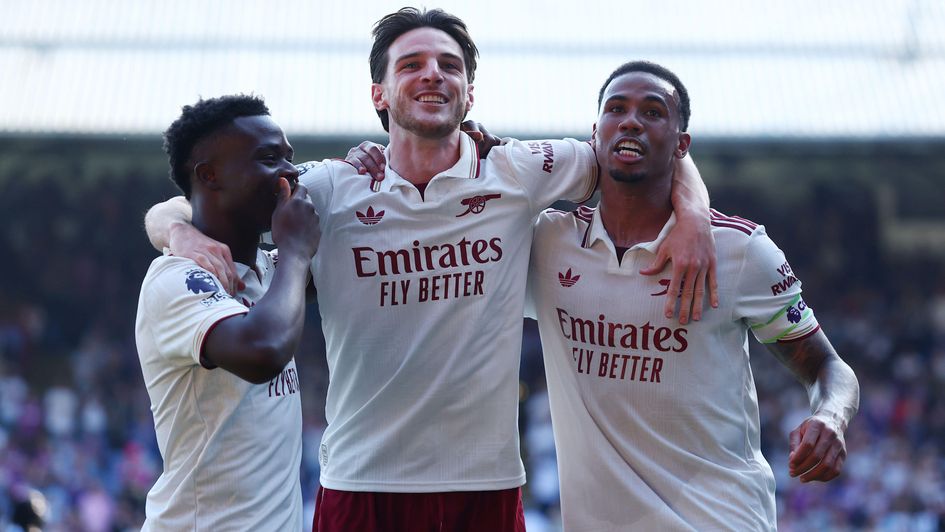
The Champions League final is just a bonus.
No club in European football history has enjoyed the privilege of that statement until Arsenal, which is an especially unlikely first considering they are without doubt the biggest club in Europe that has never won the trophy.
As little as a year ago it felt like Arsenal might never win the Champions League and that Mikel Arteta might never win the Premier League title. They are on the precipice of winning both, two weeks apart.
Victory over Paris Saint-Germain on Saturday evening would make this the greatest season in Arsenal’s entire history and one of the best English football has seen, too, given that on only five previous occasions has an English club won both competitions in the same year.
More significantly, it would eradicate the last remnants of the once-popular opinion that Arsenal have been too boring, defensive, or just plain lucky to be deserving champions.
Already that idea is fading, an inevitable process that occurs every year when the details slip away and all that remains fixed in memory is the name on the trophy.
Arsenal won the league by seven clear points – and they won one more point than Liverpool last season, who were praised at the time without any of the unfair caveats attached to Arteta’s side.
The caveats are disappearing.
There will be none left if Arsenal win on Saturday, just the creation of a new legendary era in English football, one of defensive power and determination not dissimilar to Jose Mourinho’s first Chelsea side.
And Arsenal can definitely do it. In fact, there is good reason to see them as favourites.
The sheer attacking brilliance in the first leg of the semi-final between PSG and Bayern Munich, a game that ended 5-4 to the Parisians, had most people convinced the winner of the tie would go on to lift the trophy.
But that angle downplays the significance of some genuinely abysmal collective defending of the sort that highlighted just how rarely PSG have to face difficulty domestically.
Luis Enrique will no doubt drop off significantly for this game, playing with far greater caution, but nevertheless the semi-finals taught us that Arsenal are arguably the more streetwise team - and should not be overawed by PSG’s tactical setup.
They weren’t in the semi-finals last year, not after a 20-minute PSG blitz at the beginning of the first leg at the Emirates, when Arsenal were uncertain in a 4-4-2 formation and required a half-time change to 4-2-3-1 to gain a foothold.
From that point on Arsenal were PSG’s equals, and that should also be true for Saturday’s game, with Enrique’s side likely to lose some fluency as all teams do in major finals; “we'll have to adapt to play and defend in a different way compared to what we usually do if we want to get the better of them,” Enrique said this week.
So, we can expect a cautious match played predominantly in the middle third, with Arsenal’s brilliant defensive setup nullifying a PSG team keen to probe conservatively, without committing too many forward as they did against Bayern.
It won’t be a classic, but it does mean that Arsenal – the masters of 1-0 wins and set-piece marginal gains – have a good chance of stealing victory.
PSG have conceded five goals from set-pieces in Ligue 1 and four from set-pieces in the Champions League this season, representing 17.2% and 18.2% of their totals respectively.
This is clearly the main area for Arsenal to hit.
But the game could hinge on Arsenal’s ability to turn in possession, break the PSG press, and spin into space: only three clubs have conceded more than PSG’s 18 ‘fast breaks’ in the Champions League this season.
Bukayo Saka’s pace, Kai Havertz’s one-touch lay-offs, Martin Odegaard’s turns around the corner, and – the secret weapon – Myles Lewis-Skelly’s capacity to play on the half-turn and wriggle through a crowd are Arsenal’s most important components to get behind PSG and arrive in the final third on the counter-attack.
Those opportunities will be rare, however, and more prominent will be the one-on-ones all over the pitch. Declan Rice’s capacity to shut down Vitinha is crucial.
How makeshift right-back Cristhian Mosquera defends Khvicha Kvaratskhelia, especially when Desire Doue doubles up with him on the left, may be decisive. And the battle for space between Ousmane Dembele and Gabriel Maghalaes is an obvious one to keep an eye on.
Just a single moment will probably decide the game. PSG have fresher legs and more experience, but Arsenal have a resolve and a confidence that will make them more comfortable than their opponents in an edgy, hesitant 0-0 game state.
That gives them a very good chance of becoming immortal.
More from Sporting Life
Safer gambling
We are committed in our support of safer gambling. Recommended bets are advised to over-18s and we strongly encourage readers to wager only what they can afford to lose.
If you are concerned about your gambling, please call the National Gambling Helpline / GamCare on 0808 8020 133.
Further support and information can be found at begambleaware.org and gamblingtherapy.org.